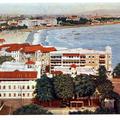
Bird's-Eye View (Bombay)
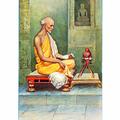
Another Dhurandhar postcard masterpiece, with the pale green background and statue of Lord Mahavir, the last Tirthankara of the Jain religion setting off the living priest in the foreground.
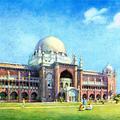
[Original caption] The Museum. As befitting an important town like Bombay, the Museum is indeed a very fine one and contains many valuable collections. [end]
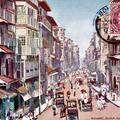
[Original caption] The Bara Bazaar, Bombay (city). The Bara Bazaar is one of the busiest spots in the city of Bombay, and is as substantial in its industries as it is in appearance.
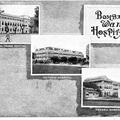
A postcard depicting hospitals in Mumbai used to treat some of the Indian troops who fought in World War I as part of the British Army.
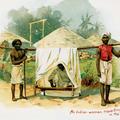
A very early postcard printed in India, most likely by The Ravi Varma Press and drawn by its chief lithographer Paul Gerhardt.
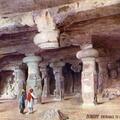
[Original caption] Entrance of Elephanta Caves. The caves are to be found on the Island of Elephanta which is situated about 6 miles from Bombay and are entered by a good flight of stone steps, constructed in 1854 at a cost of Rs.
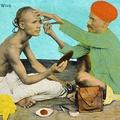
A fine example of hand-tinting and documentation on a postcard. Note how the barber's entire work kit is proudly displayed at the bottom of the image, all of which fits into a leather satchel.
![[Scene around Karla, Maharashtra]](https://www.paperjewels.org/sites/default/files/styles/square_thumbnail/public/slides/ravi-varma-811.jpg?itok=_TJ129wT "[Scene around Karla, Maharashtra]")
An unusual card from The Ravi Varma Press which shows two women walking among a crowd in a makeshift bazaar, part of a set of similar cards.
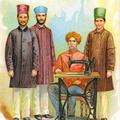
Postcards actually developed in part from advertising cards.
