State Elephant
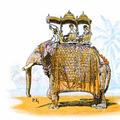
In India, elephants are revered as symbols of wisdom and good luck. Once it was common to find elephants on the roads of Mumbai.
In India, elephants are revered as symbols of wisdom and good luck. Once it was common to find elephants on the roads of Mumbai.
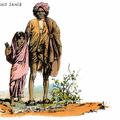
A very early postcard printed in India and signed by the Ravi Varma Press chief lithographer and also painter, Paul Gerhardt. The title "Bakshis[h] Saheb" refers to the call for alms made by beggars.
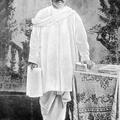
Also known as Lokmanya ("accepted by the people as their leader") Tilak, this Maharashtran was one of the first leaders of the Independence Movement, and someone who used the plague and other injustices of British rule to rally people around the cry
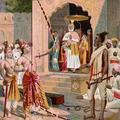
[Original recto] Sita's Marriage :–Marriage of Sita with Rama. [end]
"Sita's Marriage" is a treasured story from the great Indian epic, the Ramayana.
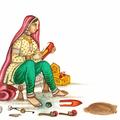
This is a hand-painted postcard from around 1905, rather rare in India compared to, say, China where at the time numerous hand-painted postcards were being sent abroad.
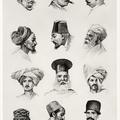
This is actually a real photograph postcard of a water colour on paper by M.V. Dhurandhar, part of a series by the artist on the people of Bombay. The recent and first major book on him, M.V. Dhurandhar The Romantic Realist (DAG, 2018) has three of
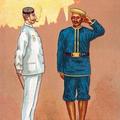
A rare lithograph from 1907 or beyond. Note the British policeman in side profile, the local constable saluting him. They are nearly the same height. The background reveals itself to be a cutout of the city, the policeman's terrain.
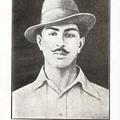
Bhagat Singh, who was hung in a Lahore jail on March 23, 1931 is the subject of continuing dispute in Lahore. Motions have been filed to name what is now a traffic chowk after Bhagat Singh. From The Times of India story: "Bhagat Singh Memorial
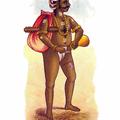
A curious case of an Italian word finding itself stamped upon a postcard of a characteristic type in India (the fakir, in this case a mendacious one). Mountebank is an old word for a charlatan, or salesman of quack medicines.
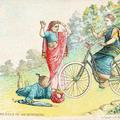
A interesting very early lithographic card from Bombay by the little-known city artist/publisher W. Cooper, who seems to have specialized in the risque postcard (the same woman seems to be the model for A Trysting Place). Two things are particularly
