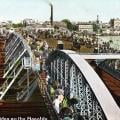
The pontoon bridge that bound the railway station and other sites on the farther bank of the Hooghly river to the main city in the foreground (it was replaced in the late 1930s by the iron Howrah Bridge).
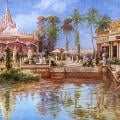
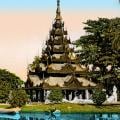
[Original caption] Jain Temple. Calcutta has been called a City of Palaces, and it has certainly a number of imposing buildings, including the Temple in the picture.
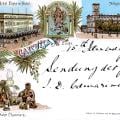
[Original back of advertising card] Alastor-Mystic-The Astrologer, Handreader and Clairvoyant from England. May be Consulted Daily at the Great Eastern Hotel, Calcutta, Room 59. (Hours 10 A.M. to 7 P.M. or by Appointment).
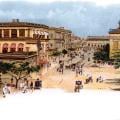
A very early lithographic postcard of Calcutta, postmarked as early as the first half of 1899, and published from Budapest, then part of the Austro-Hungarian empire.
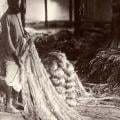
A moody postcard illustrating a manufacturing step in the jute export industry. Jute packaging materials were used around the world, particularly in gunny bags.
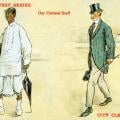
The babu, or educated Bengali bureaucrat, could be said to have held the Raj in the twirl of an umbrella. Babus were a new species that blossomed during colonial rule, hybrids of Western needs and Indian traditions.
[Original] Durga - Great Eastern Hotel - Telegraph Office - Snake Charmers [end]
A card from the earliest known series of Calcutta postcards by the Austrian photographer W. Roessler whose photographs are likely the source of the four images on the…