Tanga Stand (Murree)
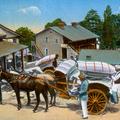
Before the advent of the motor car the tonga or open horse-drawn carriage was a popular mode of transporting humans and goods in the Indian subcontinent.
Before the advent of the motor car the tonga or open horse-drawn carriage was a popular mode of transporting humans and goods in the Indian subcontinent.
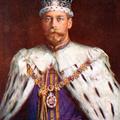
[After the original painting by I. Snowman, from official sittings graciously granted by His Majesty.
[Original caption] His Most Excellent Majesty George V.
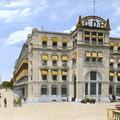
The Grand Orient Hotel is located on the waterfront in the Fort area of Colombo. The GOH (note initials at top of the building) as it is commonly known, was built in 1837 for British soldiers. In 1875 it was converted into a hotel.
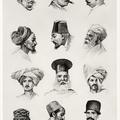
This is actually a real photograph postcard of a water colour on paper by M.V. Dhurandhar, part of a series by the artist on the people of Bombay. The recent and first major book on him, M.V. Dhurandhar The Romantic Realist (DAG, 2018) has three of
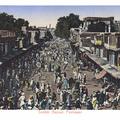
The central bazaar in Peshawar, capital of the North West Frontier Province (NWFP, now KPK) was a common postcard subject, even for distant publishers like H.A. Mirza in Delhi. Murrays Handbook for Travellers in India Burma and Ceylon (1928) wrote:
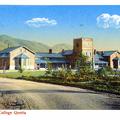
The Staff College for the British Indian army was moved here in 1907 and became the main senior training center until Partition; since then it is the Pakistan army's main educational facility.
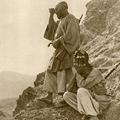
One of Holmes most popular images, with "trans-border type" referring to tribesmen who floated between Afghanistan and the Northwest Frontier Province (NWFP) border areas.
This not postmarked card had this written on the back: "These are what wear
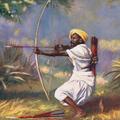
[Original caption] Aboriginal, Rajputana. Rajputana is an administrative territory of India. It lies between Sind, the Punjab, the North-Western Provinces, and the several native states of Central India.
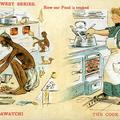
A humorous card by one of the largest Raj retailers, comparing Western and Eastern cooks and procedures. It is signed by the artist Geo[rge] D. and dated [19]11 in the bottom right corner.
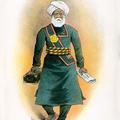
Hobson-Jobson's, the famous dictionary of Anglo-Indian terms, defines Chuprassy as "the bearer of a chapras, i.e. a badge-plate inscribed with the name of the office to which the bearer is attached. The chaprasi is an office-messenger, or henchman,
