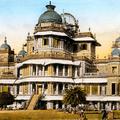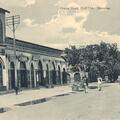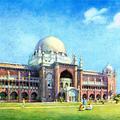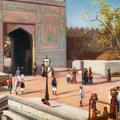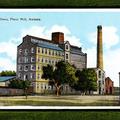
Congress Hall, Franco-British Exhibition, 1908
Postmarked Oct. 7, 1908, Birmingham and sent to Miss Jeffreys, 1, Northfield End, Henley-on-Thames [UK]: "Monday. Dear Auntie, Have you been to the Exhibition yet we have and it is Grand.
A moneylender strutting through the public square, carrying the ominous red books he uses to chase debtors through the courts, the vibrant city his backdrop.
[Original caption] Indian fruit is varied and luscious. Among the most popular are melons, guavas, bananas and mangoes. These, and others, are readily bought, and the fruit stall is a flourishing institution in every Indian bazaar. [end]
From a
Among the earliest known postcards of Kolkata, by a local and likely Austrian,photographer. Note the four tiny titles below each vignette for those eager to know.
[Original caption] The Moti Musjid. The Moti Musjid or Pearl Mosque, designed by the Moghal Emperor, Shah Jehan, 1625-58, glistens as the sun gleams on the dazzling white marble.
[Original caption] Performing Bears, Calcutta. It is a common occurrence in Calcutta and other cities of India to meet the native from the hills leading a small bear that is found in the Himalayas and other mountain districts.
A superbly composed Bremner image, from the trees and boat in the foreground, the reflective lake stretching back towards a Hindu temple on the banks.
[Original caption] Madras, Seven pagodas. This is the largest of the Seven pagodas of Mahabalipuram (once a city and now a village), 35 miles south of Madras.
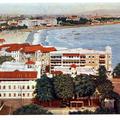
[Original caption] Bird's Eye View of Fort from Taj Mahal Hotel, Bombay.
Built in the early 1630s by the Emperor Shah Jehan, the "Palace of Mirrors" or "Crystal Palace" in Lahore Fort is full of glass tiles that reflect light. A UNESCO World Heritage site, the roof was only recently properly restored.