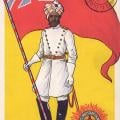
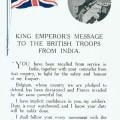
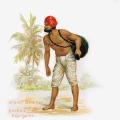
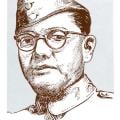
A beautiful lithographic postcard celebrating an Indian soldier in World War I. Published in Lausanne, Switzerland, its design is exquisite: the flag just breaks the white border in a field of red, and features a faux postmark from the campaign.
[Verso Original handwritten caption] After an argument with the sails of a sampan. [end]
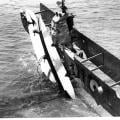
An unusual real photo postcard of the Fairey IIID, an early 1920s British seaplane that "was popular with aircrew but they were difficult to maintain and when…
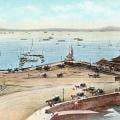
The pier across the Taj Hotel where the Gateway to India now stands. This area was expanded with a sea wall and entry steps before the Gateway to India was completed in 1924. The Japanese-style pavilion seen here was removed.
Over a million Indian troops served as part of the British forces in World War I; postcards were used to help recruit them, often in languages like Gujarati, though this card seems to have been intended more for British troops already serving in…
An early advertising card for the West End Watch Co. in Bombay (373 Hornby Road) and Calcutta (14 Dalhousie Square), produced by a famous Swiss printing house.
The Sri Lankan tea industry grew from 250 acres under cultivation in 1876 to almost 400,000 acres in 1900.8 Some 150 million tonnes of tea were produced in 1900 worth 50 million rupees, half of Ceylon’s total exports.
This card is from a series of 6 postcards by the unknown painter E.E. probably self-published around 1910. It is of unusual size, and came in a nice envelope with the imprinted title Six Artistic Views of Kashmir.