Lucknow. La Martiniere
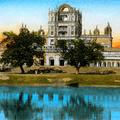
La Martiniere College initially consisted of a splendid eighteenth century residence, to which other structures have been added over the years.

La Martiniere College initially consisted of a splendid eighteenth century residence, to which other structures have been added over the years.
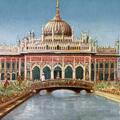
Chota Imambara, a Lucknow landmark, is also called the Husseinabad Imambara. This monument, built as the mausoleum for Muhammad Ali Shah, was completed in 1837 and is part of the Kaiser Bagh complex.
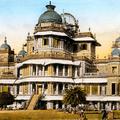
Lucknow, the capital of the state of Uttar Pradesh, is often called the "city of the Nawabs."
The pillars, domes and minarets of Kaiser Pasand drew on Mughal architecture and European styles popular among Lucknow's ruling class in the 1820s when the
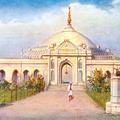
[Original caption] Shah Najaf Mosque. Lucknow.
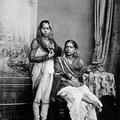
Professional dancing girls were among the most popular early postcard subjects. These two dancing girls are probably from Lucknow as the painting in the studio background on the left recalls the Chutter Manzil in Lucknow.
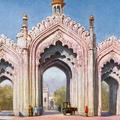
[Original caption] Hooseinabad Gateway. Gateway to the tomb of Muhammad Ali Shah, who erected here his own tomb in 1837. The florid excess of stucco ornamentation is but one sign of the decay of Indian architecture in modern days. [end]
One of the
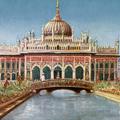
Chota Imambara, a Lucknow landmark, is also called the Husseinabad Imambara, and was built as the mausoleum for Muhammad Ali Shah, the Nawab of Awadh. It was completed in 1838 and is part of the Kaiser Bagh complex.
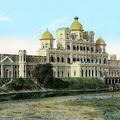
One of the most famous palaces in Lucknow, built by Nawab Ghazi-ud-Din Haider in the early 19th century, the Chattar Manzil epitomized the eclectic mixture of European and Indian architectural styles that made Lucknow so photogenic for early
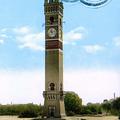
Two carefully positioned stamps at the top, according to the then prevailing "language of stamps" would say "Write soon." This is what the message – using the numbers associated with postcard collector rings – suggests as well.
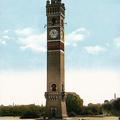
Apparently the tallest clock tower in India, this 221-foot high structure was constructed in the 1880s.
