Road Sweeper
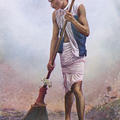
This finely lithographed card by Clifton & Co. was one of the their most popular images, and produced in multiple black and white formats. Originally from a photograph, this colored version would have required multiple print runs.
This finely lithographed card by Clifton & Co. was one of the their most popular images, and produced in multiple black and white formats. Originally from a photograph, this colored version would have required multiple print runs.

Another exuberant, deftly rendered very early postcard by Paul Gerhardt, chief lithographer at the Ravi Varma Press in Bombay. Note the simply drawn mosque minarets, the colors that pull you in while the cart pushes out into the foreground space.
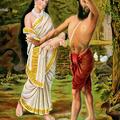
Vishvamitra was a revered sage in ancient India; this postcard from one of Ravi Varma's most famous paintings shows how he rejects knowledge of his child by turning away and hiding his gaze with a dramatic gesture.
[Original caption] Menaka sent by
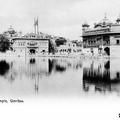
This postcard is probably among the earliest of the Golden Temple in Amritsar, given the undivided back, and Clifton's role as one of the earliest all-India postcard publishers. It is probably from a 19th century albumen print.
This card was sent
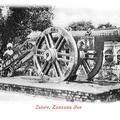
The gun in front of Lahore Museum that was made famous in Rudyard Kipling's novel Kim which begins "He sat, in defiance of municipal orders, astride the gun Zam-Zammah on her brick platform opposite the old Aijab Ghar–the Wonder House, as the natives
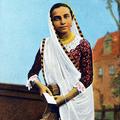
Parsis in India originally came from Iran (Persia), and Parsi ladies were among the first Indian women to have had an active public life, no doubt helped by a high literacy rate in the community (there is a postcard or letter in the woman's hand).
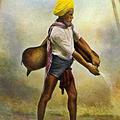
The bhistee or water carrier was a critical support to urban life before running water became widespread and reliable, and is one of the most frequent postcard subjects.
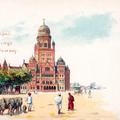
When this postcard was published in 1899, the BMC building as it has come to be known across of Victoria Terminus railway station had been open barely six years.
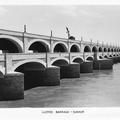
Lloyd Barrage is now called the Sukkur Barrage
Lloyd Barrage was opened 1932 in Sind province on the lower Indus River area. It was the largest irrigation project ever undertaken, and brought over 6 million acres under cultivation.
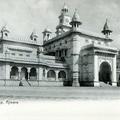
Mayo College in Ajmer, Rajasthan, which bills itself as the best boys boarding school in India, was founded in 1875 by the the 6th Earl of Mayo who was also the Viceroy of India from 1869 until 1872, when he was assassinated by a convict on the
