Rajputana Aboriginal
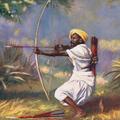
[Original caption] Aboriginal, Rajputana. Rajputana is an administrative territory of India. It lies between Sind, the Punjab, the North-Western Provinces, and the several native states of Central India.
[Original caption] Aboriginal, Rajputana. Rajputana is an administrative territory of India. It lies between Sind, the Punjab, the North-Western Provinces, and the several native states of Central India.
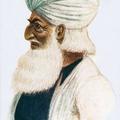
One of siz postcards in Raphael Tuck & Sons first "Native Life in India" series, which featured the work of an artist with the initials G.E.M. who remains unidentified.
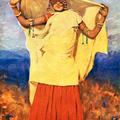
[Original caption] A Belle of Northern India. The women of Delhi and district are, to Western eyes, rather more pleasing than those of many other parts of India.
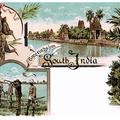
One of the earliest roughly dateable postcards of India, made by a German firm that soon seems to have vanished from history. It probably dates to 1896, when a similar card of Haiti was made (see Haiti's First Postcard by Peter. C. Jeannopoulus in
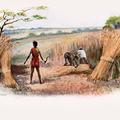
One of those postcards which remind you what an exceptional artist M.V. Dhurandhar was. In the midst of a harvest, with giant sheaves of the crop as if pulled apart like curtains, stands a woman in red with sickle in hand.
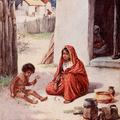
According to the Indian census of 2001, 74% of the population of India lived in 638,365 different villages.

An advertising card for one of the big London-based steam-ship travel firms who served the travel-between-India and Europe market.
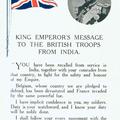
Over a million Indian troops served as part of the British forces in World War I; postcards were used to help recruit them, often in languages like Gujarati, though this card seems to have been intended more for British troops already serving in
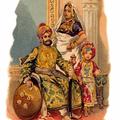
Many of the earliest postcards were actually advertising cards, given the expense of producing lithographic cards like this French view of a 17th century Nawab and son. The woman in the back holds a nautch girl's pose.
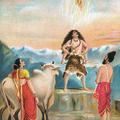
[Original caption] Shankar receives the river Ganga on his head in compliance with the prayers of Bhageeratha. [end]
This image is from a famous painting by Raja Ravi Varma (1848-1906), one of India's most important painters.
