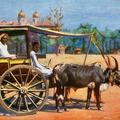
A Native Bullock Cart, Northern India

[Original caption] A Native Bullock Cart, Northern India. This most popular means of conveyance throughout India is the bullock cart.
[Original caption] A Native Bullock Cart, Northern India. This most popular means of conveyance throughout India is the bullock cart.
[Original caption] The Shigean is a small two-wheeled vehicle in use in Bombay and other Eastern cities. As a rule it is drawn by a couple of small oxen of the Zebu family.
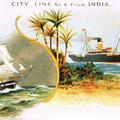
One of the reasons that postcards became so popular around the turn of the century was because of the growth of shipping and railway lines that let people and postcards move rapidly from place to place.
![La Guerre Europeenne de 1914 [The European War 1914]](https://www.paperjewels.org/sites/default/files/styles/square_thumbnail/public/slides/la-guerre-europienne-de-1914.jpg?itok=HBwYAltn "La Guerre Europeenne de 1914 [The European War 1914]")
[Original caption translated] "Indian vehicle harnessed with 2 mules used for refueling [end]. One of many French postcards celebrating Indian troops who fought on the Allied side in World War I. Note the snow on the ground.
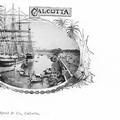
An example of how the earliest postcards of a place were often design masterpieces. Note how the palm tree merges with the ship masts, and nautical rope and elements carefully surround the whole frame.
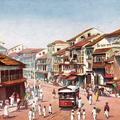
[Original caption] Pydownie Stree, Bombay (City). Pydownie Street, one of the principal highways of Bombay, is typical of the many animated thoroughfares of this busy city.
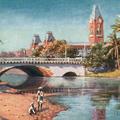
[Original caption] Madras, Central Station. This is one of the largest and finest stations in all India.
![High Class People [handwritten]](https://www.paperjewels.org/sites/default/files/styles/square_thumbnail/public/slides/high-class-people_0.jpg?itok=Qp0_hSBg "High Class People [handwritten]")
An unusual humorous hand-painted postcard, as if riding high on a camel makes someone "high class." Hand-painted postcards seem in style to echo much earlier 19th century Company painting styles.

Engineering feats were a common theme on early postcards, particularly those which also had an "imperial" or conquest sub-text. especially in the western part of the Raj like Balochistan.
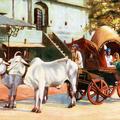
[Original caption] Zenana Carriage, Jeypore. This picture of the quaint and thoroughly Oriental-looking vehicle was taken in a street of Jeypore, the capital of the state of that name in Rajputana.
