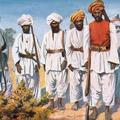
Group of Baland Khels
[Original caption] Baland Khels. This tribe inhabits the North-West frontier of India, close to the native state of Afghanistan, the boundary between their provinces and the Indian states being the River Kurram.
[Original caption] Baland Khels. This tribe inhabits the North-West frontier of India, close to the native state of Afghanistan, the boundary between their provinces and the Indian states being the River Kurram.
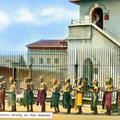
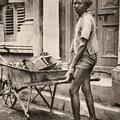
D. A. Ahuja published a number of postcards of Rangoon jail, including the scene just before this one, while they are waiting for their breakfasts. According to one account of the Burmese prison system, "The annual reports on the prison
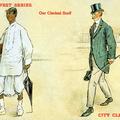
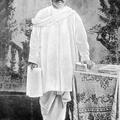
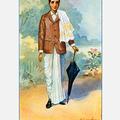
The babu, or educated Bengali bureaucrat, could be said to have held the Raj in the twirl of an umbrella. Babus were a new species that blossomed during colonial rule, hybrids of Western needs and Indian traditions.
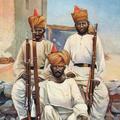
This postcard appeared in connection with the publication The Armies of India by Col. A.C. Lovett and Major C.F. MacMunn (1911). Lovett served as illustrator, A. & C.
[Original caption] The native tribes of India have, since the first occupation of the country by the British, been trained to act as soldiers to guard their own districts.
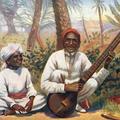
[Original caption] A Native Musician in Peshawar, a town and district in the Punjab province near the entrance to the Khyber Pass.
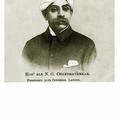
Sir Narayan Ganesh Chandavarkar, an early Hindu reformer and political leader, was born in Karnataka in 1855. He later became vice-chancellor of the University of Bombay where he spent most of his life working as a Justice, activist and reformer.
The word "Dhangar" owes its origin to the Sanskrit word "Dhenu" (cow), and apparently refers to a caste of people associated with herding primarily in Maharashtra, but also throughout India.
Also known as Lokmanya ("accepted by the people as their leader") Tilak, this Maharashtran was one of the first leaders of the Independence Movement, and someone who used the plague and other injustices of British rule to rally people around the cry
A rare lithograph from 1907 or beyond. Note the British policeman in side profile, the local constable saluting him. They are nearly the same height. The background reveals itself to be a cutout of the city, the policeman's terrain.