Afraid of his Complexion
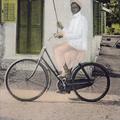
Or is he trying to keep cool? This series of humourous postcards seems to feature the same protagonist.
Or is he trying to keep cool? This series of humourous postcards seems to feature the same protagonist.
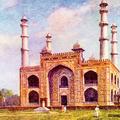
[Original caption] Entrance to Akbar's Tomb, Agra. The Mausoleum of the Emperor Akbar who reigned 1488-1518 A.D. is some distance from the cantonment at Agra. On the way to it is a sculptured horse to commemorate a favourite of the Emperor.
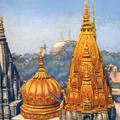
[Original caption] The Golden Temple. Held by many to be the oldest and holiest temple amid the 1,000 temples of Benares, the holiest city in India.
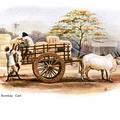
Initialed "MD" in the right corner, Dhurandhar deftly captures early Bombay life. The labourer on the cart nearly falls backwards as he pulls the box up. A pretty tree separates the bullocks from the cart.
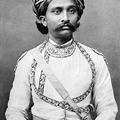
"RAJA, RAJAH , s. Skt. rājā, 'king.' The word is still used in this sense, but titles have a tendency to degenerate, and this one is applied to many humbler dignitaries, petty chiefs, or large Zemindars.
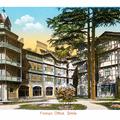
"The foreign office is a picturesque building, somewhat in the Chalet style, built in 1888. It is located near Chaura Maidan" (Gazetteer of the Simla District, 1904, p. 123). Rudyard Kipling, in his story Wressley of the Foreign Office (Plain Tales
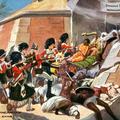
[Original caption] Seringapatam. A fortress in Mysore, India. Here Tippoo Sultan was besieged by the ENglish in May, 1799. On the 4th of May a breach was made in the walls and in seven minutes the British flag floated from the summit.
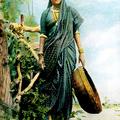
The growth of a city like Bombay was largely dependent on the work of laborers who carried bricks and building materials on wicker baskets on construction sites, much like they do today, which must be part of the reason why they were such common
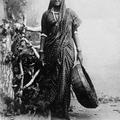
The original black and white postcard predating the color version.

[Original caption] A Chat with a Friend. This picture gives good opportunity to study the Indian dress.
