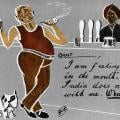
A faux pre-written postcard which gives some sense of the life at least as experienced by British soldiers in cantonments, even while holding ale in one hand and a pipe in the other: "Dear _____, I am feeling "down in the mouth." India does not…
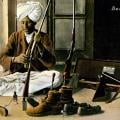
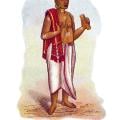
Although Hobson Jobson (1903, p. 77) defines Bearer as, besides a palanquin carrier, also as "b. (In the Bengal Presidency) a domestic servant who has charge of his master's clothes, household furniture, and (often) of his ready money.
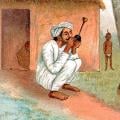
A distinctly colored postcard, with the pinkish mud offsetting the green grass and white garb of the smoker. Note the little boy and half-hidden woman watching from the hut.
This card was made primarily for domestic audiences as the Hindi title, and secondary English title cleverly tucked into a corner vertically suggest. Note how the remnants of another postcard from a skewed cut is visible at the top.
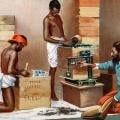
[Original caption] The amount of tea exported from Ceylon annually exceeds 150,000,000 lbs., and about 400,000 coolies from Southern India are employed in the tea gardens.
Lord Curzon (1859-1925) served as the Viceroy of India for six years (1899-1905). His wife Mary Curzon, also shown in the juhla, wrote in her diaries about one incident that stayed with her from the Hyderabad tour in 1902: “Captain Wigram fired as…
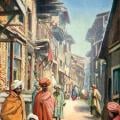
[Original caption] A Native Village Street. Although many buildings in India are solid, substantial structures of considerable architectural interest, most of the villages and towns are made up of houses built entirely of wood.
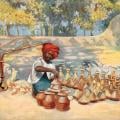
[Original caption] The Native Potter is a familiar figure in the streets of Indian towns. He places the clay on a pole, which is sunk a couple of feet in the ground, and keeping this revolving on its axis with a continuous motion of his feet, he…
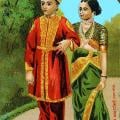
Taraporevala & Sons was the premiere Bombay bookstore and publisher, stock full of 19th century illustrated magazines and images eagerly bought and saved in trunks by artists like Ravi Varma as inspiration.