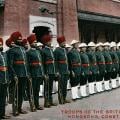
Indian policemen and soldiers were an integral part of the British Empire's law and order apparatus in its Hong Kong colony. William Quin, after becoming Captain Superintendent in 1862, initiated direct recruitment from India.
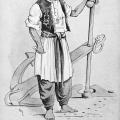
Bengal's rivers were traversed by boats and steamers, on which this man served a captain. The firm he worked for, "I.G.S.N." is likely emblazoned on his shirt.
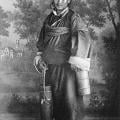
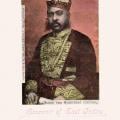
Possibly the earliest postcard of a named Indian ruler, the Nizam of Hyderabad, Mahbood Ali Khan, Asif Jah VI, one of the world's richest men and ruler of Hyderabad state from 1869 until 1911.
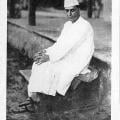
Phoenix Printing Works was one of the largest publishers of postcards of political leaders, including this less common casual view of Rashtrapati [President] Nehru in sandals.
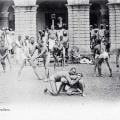
Curiously this view was not one of the more popular Clifton & Co. postcards, one of the first publishers in the city, despite its many scenes and informational value. From the building columns and the firm's location it is likely to be from Bombay.
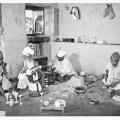
Looking at this collection of craftsmen and spare surroundings of the workshop, one realizes how much of the fine silver work from Kashmir was a matter of manual labor and skills.
[Verso] "Mission Hospital, Kolar, India.
Dear aunt Connie:
This will not reach you until after your birthday. Am sorry I did not get it off before. Hope you have a very happy day. This center piece was made in a Mission School. Much Love, Edith.
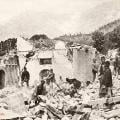
The April 4, 1905 earthquake, one of the largest in India history, killed over 20,000 people. This undivided back postcard would have been one of the first times the postcard was being put to the reporting of current events use in British India.
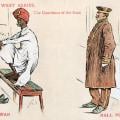
Part of an eight card set depicting the same roles but different types who fill them in India and Britain, durwan being defined as "a live-in doorkeeper, especially in an apartment building."