Jeypore Zenana Carriage
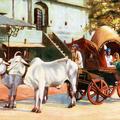
[Original caption] Zenana Carriage, Jeypore. This picture of the quaint and thoroughly Oriental-looking vehicle was taken in a street of Jeypore, the capital of the state of that name in Rajputana.
[Original caption] Zenana Carriage, Jeypore. This picture of the quaint and thoroughly Oriental-looking vehicle was taken in a street of Jeypore, the capital of the state of that name in Rajputana.
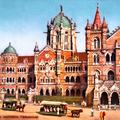
[Original caption] Victoria Terminus, Bombay (City). Bombay is by far the most European in appearance of all the cities of India. Extensive lines of tramway pass through the broad city streets that are continuously lined with splendid buildings.
From the earliest Tuck's Kolkata postcard series, when the firm did not print its later standard captions on the back of each card.
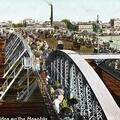
The pontoon bridge that bound the railway station and other sites on the farther bank of the Hooghly river to the main city in the foreground (it was replaced in the late 1930s by the iron Howrah Bridge). While this postcard was likely from a
A classic Dhurandhar portrait. The growing metropolis of Bombay with its modern buildings form the backdrop to a fully formed character, in traditional dress, with a quizzical expression on her face. Does she understand what is happening around her?
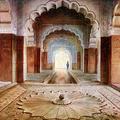
[Original caption] Interior of Taj, Agra. One of the most graceful and most impressive sepulchres in the world.
[Original caption] Golden Mosque, Lahore. This mosque has three gilt domes and was built in 1753 by Bikhari Khan, a favorite of the widow of Mir Mannu, who governed Lahore a short time after her husband's death.
[Original caption] Temple of Ramnagar. Commenced to be built by the famous Chair Singh, who in 1781 forced Hastings to retreat from Benares to the fort of Ramnagar.
From a German painted series on the different kinds of ships used along India's coasts, a subject that seems to have escaped the attention of Indian and British postcard publishers.
As far as the origin of the word Coromandel, Hobson-Jobson declared:
Dambatenne Estate, established in 1890, is still part of the Lipton's team empire. Perhaps most noteworthy about this advertising postcard is the way the woman's orange clothing is both distinct from and engulfed by the tea leaves.