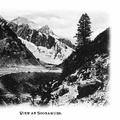
View at Soonamurg
Postmarked Dec. 19, 1903, and sent to Mr. Harington, Bath, England: “Simla 16.12.03. Thank you so much for sending the very pretty pictures cards of Bath. They don’t get them up half as well out here! Best Love, Gracie.”
Postmarked Dec. 19, 1903, and sent to Mr. Harington, Bath, England: “Simla 16.12.03. Thank you so much for sending the very pretty pictures cards of Bath. They don’t get them up half as well out here! Best Love, Gracie.”
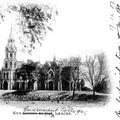
Probably the earliest postcard of Government College, Lahore (now renamed Government College University or GCU), and mislabeled by the publisher, Fred Bremner (he got it right on future versions). It's main, church-like building was completed in 1877

An almost painterly postcard when one examines the detail in the foreground of men and women workers, pounding and transporting grain; there are even people at the top left doing something under the tree.
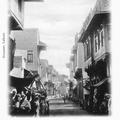
Bremner was among the very earliest postcard publishers of SIndh, and included a handful of views of Sukkur, a town not often photographed by colonial residents.
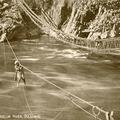
One of Fred Bremner's favorite images, also found in his autobiography. Wandering through Kashmir he wrote ". . . the eye may sometimes rest on a figure slowly gliding through mid-air with no apparent support whatever.
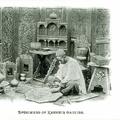
One of Fred Bremner's most popular postcards, also titled Specimens of Walnut and Copper Carving, Kashmir. The density of the collotype deepends ones appreciation of the woodworker's lifework.
Postmarked Rawalpindi, 21 Oct.
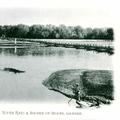
Boat bridges were common in the 19th century; not only the Ravi at Lahore, but the Hooghly in Kolkata, the Indus at Attock were all traversed by ancient boat bridges that rose or were washed away by floods, but could easily be managed and repaired.
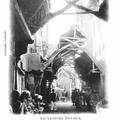
This striking image was also published in a 1924 issue of National Geographic magazine. Shikarpur is an ancient ancient trading city; its merchants have traded for centuries with different areas of Central Asia, Afghanistan and Iran.
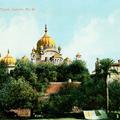
The mausoleum of the great Sikh ruler of Punjab, Maharajah Ranjit Singh.
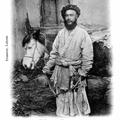
A Central Asian trader who made his way down the slippery, winding routes of the Hindu Kush, Karakoram and Himalayan ranges into Kashmir's valleys.
