[Indian Cavalry]
An early advertising card for the West End Watch Co. in Bombay (373 Hornby Road) and Calcutta (14 Dalhousie Square), produced by a famous Swiss printing house.
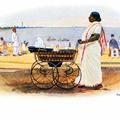
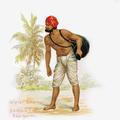
A very early India-printed postcard signed by the chief lithographer at the Ravi Varma Press, Paul Gerhardt. Gerhardt was probably aware of Ravi Varma's prize-winning painting that year, Water Bearer, and we know from Raja Varma's diaries - the great
An example of how writing could create something aesthetically appealing and seemingly become one with an image.
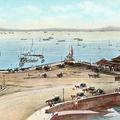
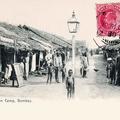
One of the most popular views of plague camps in Bombay at the turn of the century, here with a nicely positioned stamp. Postmarked June 30, 1906, Mumbai. Addressed to “Miss Amy L.
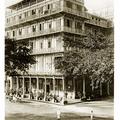
Lynne Withey writes in Grand Tours and Cooks Tours (London, 1998), about the growth of the Western tourist trade in the 1890s, that "apart from a few first-class establishments in major cities, most hotels were barely acceptable by Western standards.
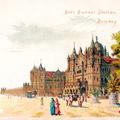
Postmarked 22 March 1905 in Bombay, and April 18 1905 in Salt Lake City, Utah. Addressed to “H. H. Rogers Esq. Konupa Makme-Kopunuka, Odessa South Russia-in-Europe." [Recto] “Magnificent station but far too big for requirements.” Today it is the
An extremely rare early postcard by an little-known lithographer, W. Cooper, in Bombay. It looks to crude to have been made at The Ravi Varma Press. Cooper seemed to prefer risque images.
Illustrated postcards actually came to Mumbai at an inauspicious moment.
The word "Pariah" owes its origin to the Pariah caste of the Hindu society of India.
Another evocative card by M.V. Dhurandhar injects personality into the roving washerman. In the background is an edifice of the "new" Bombay while in the foreground we see the age-old profession of washermen cleaning the resident's laundry.
See the