A Bania Lady
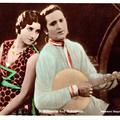
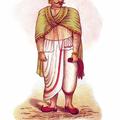
A beautiful example of colorization, with the rich brown of wood and skin set off against the black and white original studio backdrop. On the back, one owner has pencilled in "Hindu Bourgeois."
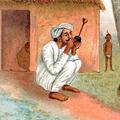
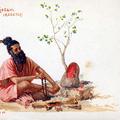
A very early postcard printed in India. Gosavi is a Marathi word that refers to someone who has renounced worldly pleasures and wears garments of the "brick-dust" color shown here.
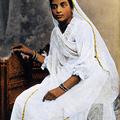
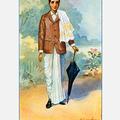
Another classic, empathetic Dhurandhar portrait that seems to capture well Hobson Jobson's (1903, p. 44) definition: "BABOO , s. Beng. and H. Bābū [Skt. vapra, 'a father']. Properly a term of respect attached to a name, like Master or Mr., and
"The stranger unacquainted with conditions in India, and visiting Bombay for the first time, cannot fail to be impressed by an inspection of the huge assortment of books which Messrs D B Taraporevala, Sons and Co find it necessary to keep in hand to
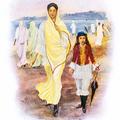
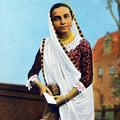
Parsi women were a popular subject—progressive women with traditional virtues, counterpoints to the nautch girl. This Parsi Lady is holding what could be a postcard.
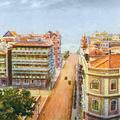
[Original caption] Apollo Bunder. Here are to be found very large and fine buildings, including the Government Docks and the Custom House and many other important Docks, etc. [end]
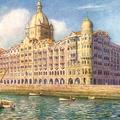
[Original caption] Taj Mahal Hotel, Bombay. Bombay, one of the most important cities in India, has an area of not less than 22 square miles.
The relationship of Parsis and athletics was a oft-discussed issue in the late 19th and early 20th century, with a tradition from Persia of Parsi marital arts and various muscle men who distinguished themselves set against popular conceptions of the
Snake charmers are one of the most common early Indian postcard subjects, and this must be one of the earliest and most beautiful such views. Note the clever use of the palm backdrop to create the illusion of depth, and the rich use of red.
B. Rigold and Bergmann were a London firm (69, Bishopsgate, London, E.C.), apparently established in 1876 that traded with India and China.