A Belle of Northern India
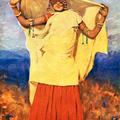
[Original caption] A Belle of Northern India. The women of Delhi and district are, to Western eyes, rather more pleasing than those of many other parts of India.

[Original caption] A Belle of Northern India. The women of Delhi and district are, to Western eyes, rather more pleasing than those of many other parts of India.
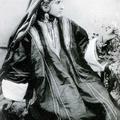
A postcard that shows off the great detail achievable in the collotype printing process.

One of those postcards which remind you what an exceptional artist M.V. Dhurandhar was. In the midst of a harvest, with giant sheaves of the crop as if pulled apart like curtains, stands a woman in red with sickle in hand.
![Thibetan [Tibetan] Woman, Darjeeling](https://www.paperjewels.org/sites/default/files/styles/square_thumbnail/public/slides/darjeeling-woman_0.jpg?itok=zqS4goau "Thibetan [Tibetan] Woman, Darjeeling")
Clare Harris in her book Photography and Tibet (Reaktion Books, 2016) writes of this postcard, "a portrait of a young woman that features prominently in The Buddhism of Tibet as a generic illustration of Tibetan femininity implies that she'd been
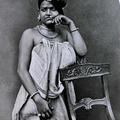
Early postcards from the Malabar Coast are uncommon.
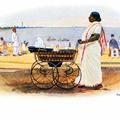
This postcard shows a nanny with a pram on the “Queen’s necklace” of Malabar beach in Bombay. The artist Dhurandhar and other fellow J.J.
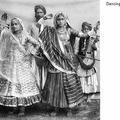
A postcard like this was the result of a careful and perhaps exhausting pose by the dancers. Note the man holding up the backdrop, which probably covered a studio wall or other scene.
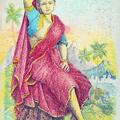
An extremely rare early postcard by an little-known lithographer, W. Cooper, in Bombay. It looks to crude to have been made at The Ravi Varma Press. Cooper seemed to prefer risque images.
![Phatani [Pathan] Dancing Girls](https://www.paperjewels.org/sites/default/files/styles/square_thumbnail/public/slides/pathan-dancers_0.jpg?itok=brZPDF7- "Phatani [Pathan] Dancing Girls")
An annual tradition in Peshawar in the early part of the 20th century and probably well beforehand, Peshwar's nautch women would dance through the streets watched and cheered by thousands of onlookers.
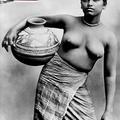
Plate & Co., like many Ceylon-based firms, published semi-nude postcards of women, more common here than even in South India, including this card with a nicely placed purple stamp.
