Canal Scene, Narsapur Taluq
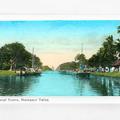
An unusual embossed scene, likely in Andhra Pradesh, where the frame contrasts nicely with the blue canal. Produced by a missionary organization, probably to raise money or advertise their activities in India.

An unusual embossed scene, likely in Andhra Pradesh, where the frame contrasts nicely with the blue canal. Produced by a missionary organization, probably to raise money or advertise their activities in India.

[Original caption] The Royal Botanical Gardens on the west bank of the river, were founded in 1780 on the suggestion of Colonel Kyd, and have been of more service to public and private gardens of the world than any other horticultural institute.
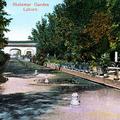
The Shalimar Gardens in Lahore, about 18 km from the Indian border at Wagah, were constructed in the 1640s by the Mughal Emperor Shah Jehan. They were inspired by his father Emperor Jehanghir's Shalimar Gardens in Srinagar, Kashmir.
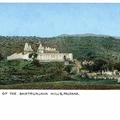
These Jain temples were constructed in memory of Ādinātha, the first of the Jain tirthankaras, who is said to have meditated here. The publisher of these unusual postcards remains elusive.
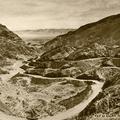
Most postcards of the Khyber Pass show the decline of the roadway towards the Afghan border at Torkham, where the Frontier of India [now Pakistan] sign stood.
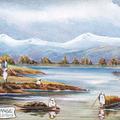
Among the earliest British-published postcards of Kashmir, this example from a series by F. Hartmann probably preceded the first Tuck's coloured Kashmir postcards by Raphael Tuck & Sons in 1906. Interestingly, both firms used an unusual caption on a
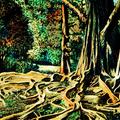
[Original caption] The tree grows to a height of 120 feet and has a large spreading head. A channel is in the bark with a cutlass for the mil to flow and is caught in gourds.
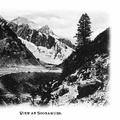
Postmarked Dec. 19, 1903, and sent to Mr. Harington, Bath, England: “Simla 16.12.03. Thank you so much for sending the very pretty pictures cards of Bath. They don’t get them up half as well out here! Best Love, Gracie.”

An example of how nicely the real photo postcard could be used to maximize the depth and mystery of black and white photography, here on glossy stock by A.W. Plate & Co., a firm which tried every type of postcard printing process.
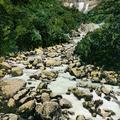
This card showing a river sacred to the Toda people and now used to generate hydroelectric power from many places was sent to Mr. Hans Lichtmess, Lenaugasse 11, Vienna VIII, Austria: [Verso, handwritten] "Received your p.c.
