Brahmins Dining. Jaipur.
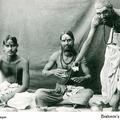
A carefully staged scene in which the cloth backdrop helps focus us on the individuality of the men.
A carefully staged scene in which the cloth backdrop helps focus us on the individuality of the men.
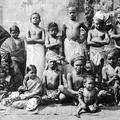
In the book Carl Hagenbeck's Empire of Entertainments by Eric Ames (2008) he describes the importance of this exotic showman and his family who helped turn "India" into a touring spectacle following an 1898 exhibition in Berlin, even if most of the
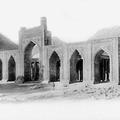
A striking collotype published in many versions by Clifton & Co. The Arhai-Din-Ka-Jhopra was built in the 13th century by the first Muslim Sultan in India, Qutb-ud-Din Aibak, and before him by Abu Bar of Herat, Afghanistan.
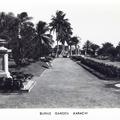
"After the merciless grind of a rough day," wrote the Sindhi writer and nationalist Ibrahim Joyo (1915-2017) in his short story In the Name of Allah, "how soothing it is to feel the balmy breeze in Karachi's Burns Gardens, especially on a fresh
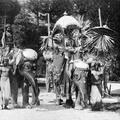
In Ali Raza's excellent book Revolutionary Pasts Communist Internationalism in Colonial India (Tulika Books, 2022) there is this note from a police report in 1926: "A public meeting was held . . . under the auspices of the Nau Jawan Bharat Sabha to
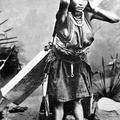
Although taken in the firm's studio, with the woman posing upright, one can from this portrait and the wooden beam infer the literally backbreaking work hillstation workers endured.

An embossed frame sets off a rare early postcard of what is presumably the famous Pushkar fair, with the colonial perspective of a onetime owner scrawled across the top: "Does not look much like our Cattle Shows."
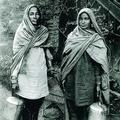
This postcard is likely based on a portrait by Johnston & Hoffmann of 22 Chowringhee [also Chourangi] Road, Kolkata, one of the most storied photographic firms in British India.
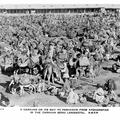
[Original] A Caravan on Its Way to Peshawar from Afghanistan in the Caravan Serai Landikotal N.W.F.P. [end]
Postcards like this illustrate how enormous the trade through the Khyber Pass once was. The Peshawar District Gazetteer 1897-98 put the value
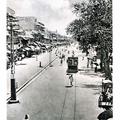
[Original caption on back] This famous street was built by Jahanara Begum daughter of Emperor Shah Jehan. It extends 1520 yards in length from Delhi Fort to Fatehpuri Mosque, and is 40 yards [wide].
