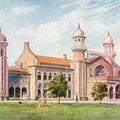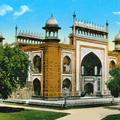
Secundra, Entrance To Akbar's Tomb
A delicately hand tinted view of Akbar's Tomb outside Agra, built by his son Jehanghir between 1605 and 1613.
Mr. Hartmann did good publicity in The Picture Postcard, a London-based magazine for early British postcard collectors and enthusiasts. Most likely its editor E. W.
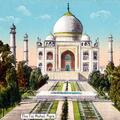
Sheikh Mujibur Rahman, also known as Bangabandhu, the leader of Bangladesh's Independence movement, had this description of visiting the Taj in 1946:
"We left the hotel soon after we had taken our baths since we were all eagerly looking forward to
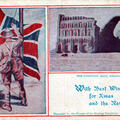
Presented by the Women of Bombay Presidency, this postcard was used to raise funds and support the British and Indian troops fighting in Mesopotamia (modern Iraq) against Turkish forces in World War I.
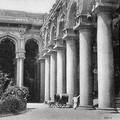
This 17th century palace, now known as Thirumalai Nayakkar Mahal, was built by King Tirumala Nayaka, of the Nayaka dynasty, and was once spread over a much larger area than what remains today.
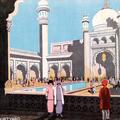
This promotional postcard for the British Empire Exhibition in London in 1924 was signed by Ernest Maitland Coffin (1868-1944), apparently a successful commercial artist.
The publisher seems to speak to the Indian customers with this translation perpendicular to the image, and perhaps educate European ones:
[Recto]"Translation in English from the Arabic written on her tomb"
"He is alone everliving and everlasting".
[Original caption] Commenced in 1637 and completed in 1648 A.D. by the Emperor Shahjahan. Wonderful Building in the world. [end]
An exceptional early lithographic card from the famous German exotic people's promoter and founder of Berlin's zoo. The title says it depicts an Indian coffee house.
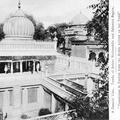
One of the most popular early views of Kolkata, this Jain is dedicated to Sitalnathji, the 10th of the 24 Jain tirthankaras.