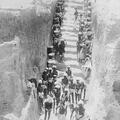
Famine relief Work. Digging the big well
While it is unclear where and when this postcard was taken, it could have been in 1899-1900 when there was a large famine in Hyderabad with relief works photographed by Raja Lala Deen Dayal.
Although opium was a major crop in the rise of the East India Company, and India the major producer of opium sent to China, with production carefully taxed and recorded, barely a handful of postcards seem to acknowledge the crop and its manufacture.
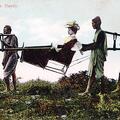
While the word "dandy" suggests being fashionable, and may be a secondary meaning, the word is said to actually come from "dandi" or the Hindi/Urdu word for stick, which are used to distribute the woman's weight across them men's shoulders.
Another
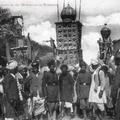
Not too far back, the local Hindu, Sikh and Christian communities would participate in the Shia Taziah processions in Peshawar.
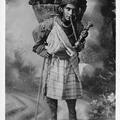
Many postcards speak to the physical labor that allowed residents of hillstations to warm their homes and cook their food, often leading men and women with permanently bent backs.
[Original caption, Verso, translated
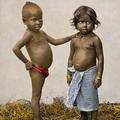
Santals are an Austroasiatic-speaking Munda ethnic group in Bengal, Bihar and elsewhere.
A thematically most unusual postcard.
Satyendra Prasanna Sinha, 1st Baron Sinha (24 March 1863 – 4 March 1928), was a prominent British Indian lawyer and statesman who achieved several notable firsts, including being the first Indian to become Advocate-General of Bengal (1905), first
A very early Tuck's postcard of India, and likely among the earliest of Darjeeling. Made from an albumen photograph by Bourne & Shepherd, whose credit is visible on the bottom right of the photograph.
Postmarked May 24, 1919, some six months after World War I was over, though the card itself is probably dated earlier. Note the European man apparently smoking a pipe in the background.