Hindu Woman.
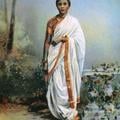
Hindu woman wearing a white sari. Getting the shades and printing correct, especially the white, on this card would have required great skill, and apparently was done by the leading early German postcard printer Knackstedt and Roder.
Hindu woman wearing a white sari. Getting the shades and printing correct, especially the white, on this card would have required great skill, and apparently was done by the leading early German postcard printer Knackstedt and Roder.
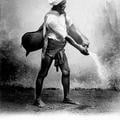
The Pakistani poet Daud Kamal (1935-1987) has a poem entitled Water-Carrier:
More patches on his clothes
than on the empty goatskin
slung across his shoulder.
Like the others
he waits his turn
at the Municipal tap.
Twice a day
he delivers water
free
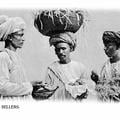
A very popular image, also published in a hand-colored version by D. Macopolo & Co.
Postmarked with no message at the Sea Post Office, likely Bombay May 6, 1905 and sent to Miss Adelaide McConway (sp?), 252 Bishop St., Montreal, Canada.

Note the title, which attempts to justify the nude image as some sort of ethnographic study.
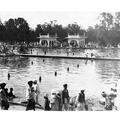
Hector Bolitho, the biographer who spent time in Pakistan in the early 1950s researching his book Jinnah: Creator of Pakistan (1954) wrote this about the Shalimar Gardens:
"While I was in Lahore I made a habit of rising at five o'clock each morning
![[Woman at loom]](https://www.paperjewels.org/sites/default/files/styles/square_thumbnail/public/slides/woman-at-loom_0.jpg?itok=KOmoyvGo "[Woman at loom]")
K. Lall & Co. were a publisher of interesting real photo postcards, like this one of a cotton spinner, whose flat composition speaks to a style of portrait photography not common among photographers.
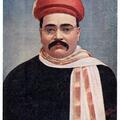
Gopal Krishna Gokhale (1866–1915) was a leading moderate nationalist, social reformer and parliamentarian in early 20th‑century India, best known as founder of the Servants of India Society and as an important political mentor to both M. K.
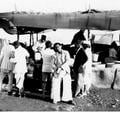
The Karachi Congress party meeting, held six days after Bhagat Singh was executed on March 23, 1931, was a tense affair.
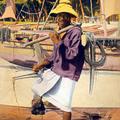
John & Co., Ceylon was an early 20th‑century commercial postcard and view‑card publisher based in Colombo (and very likely also Kandy), part of the broader trade in photographic and printed views of colonial Ceylon.
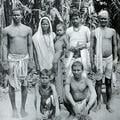
Indian workers were brought over by the British to the West Indian island of Jamaica between 1845 and 1917. Roughly 37,000 people were brought over under an indentured labor system, where they had to work on mostly sugar estates, where strict
