Greetings from Delhi
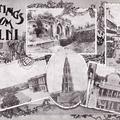
An early Greetings from Delhi postcard that seems to have been constructed from a number of other postcards given the way the titles appear on the images.
An early Greetings from Delhi postcard that seems to have been constructed from a number of other postcards given the way the titles appear on the images.
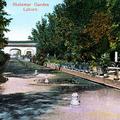
The Shalimar Gardens in Lahore, about 18 km from the Indian border at Wagah, were constructed in the 1640s by the Mughal Emperor Shah Jehan. They were inspired by his father Emperor Jehanghir's Shalimar Gardens in Srinagar, Kashmir.
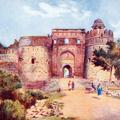
[Original caption] Old Fort. Between the Mosque and the Jumna river stands the Fort–the ancient stronghold and palace of the Mogul emperor. A towering wall of red sandstone encloses it, moated and battlemented. [end]
Better known today as the Purana
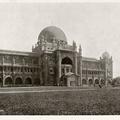
[Original caption] The Museum. As befitting an important town like Bombay, the Museum is, indeed, a very fine one, and contains many valuable collections. [end]
This postcard was likely printed soon after the construction of the Prince of Wales
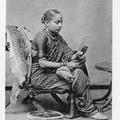
An unusual card which shows a woman, presumably a dancer, looking at the the photograph of a man, a self-reflexive trope that may or may not be recognized by us, who hold the postcard in our hands.
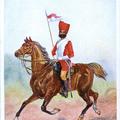
Formed in 1865, the Governor's Bodyguard was a colorful, often-illustrated cavalry in their red and white uniforms and mustachioed Rajput horsemen.
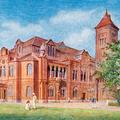
[Original caption] Victoria Hall, built 1883-1888 in honor of the Empress of India, was designed by Chisholm in keeping with the style of the Central Railway Station, one of the finest in India.
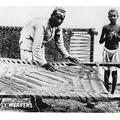
There are not that many postcards showing the charpai [charpoy], a ubiquitous feature of Indian life, defined in Hobson-Jobson (1903, p.
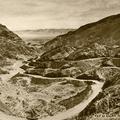
Most postcards of the Khyber Pass show the decline of the roadway towards the Afghan border at Torkham, where the Frontier of India [now Pakistan] sign stood.
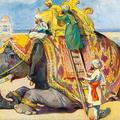
An early painted postcard, part of a series commemorating the 1903 Delhi Durbar but abstracted to something broader as "The Gorgeous East" series; note the water in the background which likely would not have been part of the Delhi Durbar.
