Temple at Ramnagar, Benares
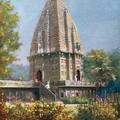
[Original caption] Temple of Ramnagar. Commenced to be built by the famous Chair Singh, who in 1781 forced Hastings to retreat from Benares to the fort of Ramnagar.
[Original caption] Temple of Ramnagar. Commenced to be built by the famous Chair Singh, who in 1781 forced Hastings to retreat from Benares to the fort of Ramnagar.
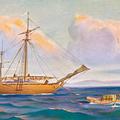
From a German painted series on the different kinds of ships used along India's coasts, a subject that seems to have escaped the attention of Indian and British postcard publishers.
As far as the origin of the word Coromandel, Hobson-Jobson declared:
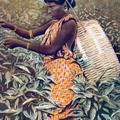
Dambatenne Estate, established in 1890, is still part of the Lipton's team empire. Perhaps most noteworthy about this advertising postcard is the way the woman's orange clothing is both distinct from and engulfed by the tea leaves.
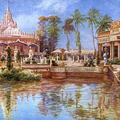
[Original caption] Jain Temple. Calcutta has been called a City of Palaces, and it has certainly a number of imposing buildings, including the Temple in the picture.

Paharis refers to the indigenous hill people who lived around Shimla and populated a large area in the lower Himalayas.
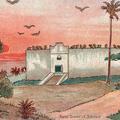
A beautiful lithograph postcard featuring one of the most popular early postcard subject, the Parsee Tower of Silence on Malabar Hill in Bombay, where bodies are placed to be eaten by vultures waiting on the rim of the structure.

[Original caption] Woman Water Carrier. It is no unusual sight in India to see women performing manual labour, and in some cases they perform harder tasks than the men.
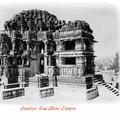
An early undivided back postcard by The Phototype Company in Bombay, probably from its first pan-India series characterized by very high printing quality and red titles.
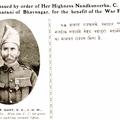
[Original caption] Jemadar Mir Dast 5th Wilde's Rifles. Won the V.C. for great bravery in the fighting around Ypres. Issued by Order of Her Highness Nandkunverba, C.I. Maharani of Bhavnagar, for the benefit of the War Fund. [end]
From a series of
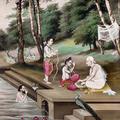
This postcard is actually an exquisite work of art, signed by the Nathdwara artist A. Ghasiram. Nathdwara in Rajasthan was a center of "Pichwai" painting for centuries.
