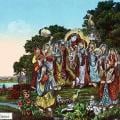
An unusual postcard featuring Krishna's sacred dance with the gopis. This card was sent to a Miss Bourn, 8 Union Lane, High Street, Strafford, London E 15 from Sergeant Bourn, Rangoon, Burma:
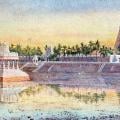
[Original caption] Mylapore Tank. Madras is built in a straggling fashion along the seashore. Most of the roads run between avenues and are flanked by groves of palms and other trees.
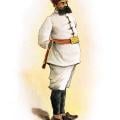
The Indian Councils Act of 1861 was the foundation for the Indian Police Service, one whose fine exemplars was this Calcutta Policeman, which the emblem on his belt so proudly proclaims.
[Verso] In Commemoration of the Visit of the German Crown Prince to East Asia 1910-1911 [end]. A spectacular postcard published in honor of the German Crown Prince Ferdinand's visit to India.
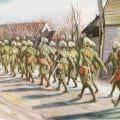
About 130,000 Indian troops served in France during World War I, and about 9,000 died. These soldiers were revered in France for helping to liberate the country from the Germans.
A portrait of the man who made the postcard revolution possible. While the original for this may have been a photograph of an actual postman, the broad strokes make it possible that a painted portrait was used as the source.
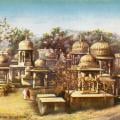
[Original caption] An Eastern Cemetery. The cemeteries of Rajputana in which is situated the state of Jeypore, are as picturesque as all that surrounds the lives of the Rajputs.
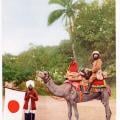
It was not just European and American tourists who came to India; this unusual postcard shows a Japanese traveler on a camel with the guide helpfully holding up a Japanese flag. The camel bags still have English names on them though.