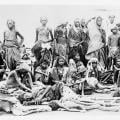
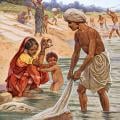
Major Indian famines were caused by droughts and poor food distribution policies. Though uneven rainfall was a major cause of Indian famines in the 19th century, faulty administrative and economic policies were equally responsible.
John Campbell Oman (1841-1911), author of The Mystics, Ascetics and Saints of India (1903) describes the incident that made him take it upon himself to write this encyclopedic work towards the end of his life.
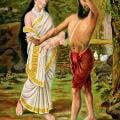
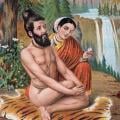
Vishvamitra was a revered sage in ancient India; this postcard from one of Ravi Varma's most famous paintings shows how he rejects knowledge of his child by turning away and hiding his gaze with a dramatic gesture.
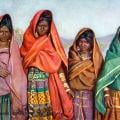
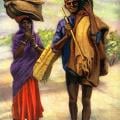
[Original caption] These folk are gypsies inhabiting the great Deccan of India. Their dress is decorated with shells, their arms are generally adorned with a large number of bracelets made of the bones of deer. [end]
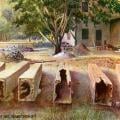
[Original caption] Ravages of White Ants: beams eaten out. The insect tribes of India may be said to be innumerable. The heat gives incredible activity to noxious and troublesome insects including Moths and Ants of the most destructive kind.
[Original caption, verso] Vishwamitra-Menaka :- This scene shows Menaka as tempting the great sage Vishwamitra, who yields to her and gets Shakuntala by her. [end]
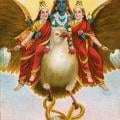
[Original caption, verso] God Vishnu with his two wives, the goddesses of the earth and the wealth, is represented as riding on his vehicle Garud. [end]
One day was often fixed each week or fortnight for washing a complete household's clothes. The concept of a washing day is said to have reflected a family's social status.
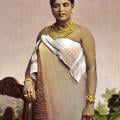
"At the peak of the Tamil drama movement, she created a sensation like no other actor. Poets penned songs in her praise, painters craved to leave their artistic impressions of her portraits, smitten kings and noblemen chased her as their dream…