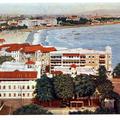
Bombay, Bara Bazaar
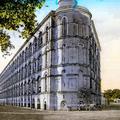
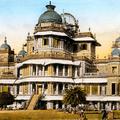
[Original caption] The Bara Bazaar, Bombay (city). The Bara Bazaar is one of the busiest spots in the city of Bombay, and is as substantial in its industries as it is in appearance.
[Original caption] The Bara Bazaar, Bombay (city). The Bara Bazaar is one of the busiest spots in the city of Bombay, and is as substantial in its industries as it is in appearance.
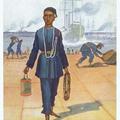
Another painted postcard by the Anglo-Indian artist Frank Clinger Scallan (1870-1950) whose Kolkata series of nearly a dozen postcards reflects the pleasures of life in what was British India's largest metropolis.
A postcard depicting hospitals in Mumbai used to treat some of the Indian troops who fought in World War I as part of the British Army.
A very early postcard printed in India, most likely by The Ravi Varma Press and drawn by its chief lithographer Paul Gerhardt.
The Buckingham Canal is an almost 500 mile long freshwater canal built in the 19th century that runs along the Coromandel coast in eastern India.
[Original caption] Entrance of Elephanta Caves. The caves are to be found on the Island of Elephanta which is situated about 6 miles from Bombay and are entered by a good flight of stone steps, constructed in 1854 at a cost of Rs.
This Mohmand conflict in 1908 was with the so-called “Hindustani Fanatics” who found sanctuary from the Sikhs in the mountains north of Swat in Northwest Frontier Province (NWFP, now KPK or Khyber Pakhtunkhwa) in the 1840s (they survive to this day).
A fine example of hand-tinting and documentation on a postcard. Note how the barber's entire work kit is proudly displayed at the bottom of the image, all of which fits into a leather satchel.
A early Mumbai postcard, with ornament weaving together three photographs of the city.
An unusual card from The Ravi Varma Press which shows two women walking among a crowd in a makeshift bazaar, part of a set of similar cards.