Baramullah, Kashmir.

An almost painterly postcard when one examines the detail in the foreground of men and women workers, pounding and transporting grain; there are even people at the top left doing something under the tree.
An almost painterly postcard when one examines the detail in the foreground of men and women workers, pounding and transporting grain; there are even people at the top left doing something under the tree.
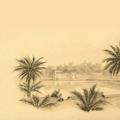
This unusual, sepia-ish lithographic postcard is probably by Paul Gerhardt at the Ravi Varma Press even though it is not signed by him with the Press imprint.
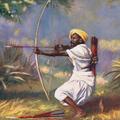
[Original caption] Aboriginal, Rajputana. Rajputana is an administrative territory of India. It lies between Sind, the Punjab, the North-Western Provinces, and the several native states of Central India.

Nautch dancers inspired stories like Hassan Shah’s The Nautch Girl, “the first known modern Indian novel” in the 1790s, as well as the first Urdu novel, the story of the Lucknow courtesan Umrao Jaan Ada in 1899.
A version of this card was sent by
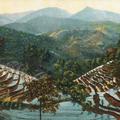
Traditional wet rice farming involves keeping the rice seeds and young plants submerged under water to keep weed infestation at bay until the young rice plants are well established.
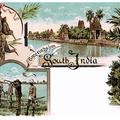
One of the earliest roughly dateable postcards of India, made by a German firm that soon seems to have vanished from history. It probably dates to 1896, when a similar card of Haiti was made (see Haiti's First Postcard by Peter. C. Jeannopoulus in
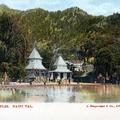
[Verso, handwritten] "Buddhist temple from which Naini Tal takes its name. Immediately behind this is the polo ground."
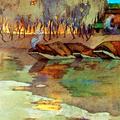
A postcard by what was probably an amateur artist, Miss L. Barne, in Madras who self-published the card as a series of six cards. [Verso] "To be obtained from Miss Barne, St. Ebbas, Madras, and from Miss Farnell, 56, Manchester Square, W. I."
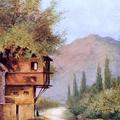
A view of the canal in Srinagar, the summer capital of the Maharajah-ruled state of Jammu and Kashmir during the Raj. This view of a house jutting over the canal was popular among photographers and postcard printers.
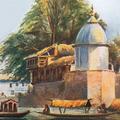
This is among the earliest postcards of Kashmir, printed for a British publisher most likely by Raphael Tuck & Sons in London just before they themselves started printing what are probably the most well-known series of Indian postcards under their
