Shabkadar Fort (Mohmand Field Force)
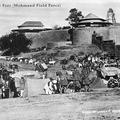
[Original hand title in albumen negative] General Willock's Residence at Shabkadr [end]
The fort at the center of the Spring 1908 battles between Mohmand tribesmen and the British-Indian army.
[Original hand title in albumen negative] General Willock's Residence at Shabkadr [end]
The fort at the center of the Spring 1908 battles between Mohmand tribesmen and the British-Indian army.
![La Guerre Europeenne de 1914 [The European War 1914]](https://www.paperjewels.org/sites/default/files/styles/square_thumbnail/public/slides/la-guerre-europienne-de-1914.jpg?itok=HBwYAltn "La Guerre Europeenne de 1914 [The European War 1914]")
[Original caption translated] "Indian vehicle harnessed with 2 mules used for refueling [end]. One of many French postcards celebrating Indian troops who fought on the Allied side in World War I. Note the snow on the ground.
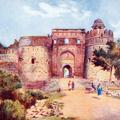
[Original caption] Old Fort. Between the Mosque and the Jumna river stands the Fort–the ancient stronghold and palace of the Mogul emperor. A towering wall of red sandstone encloses it, moated and battlemented. [end]
Better known today as the Purana
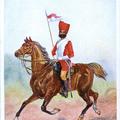
Formed in 1865, the Governor's Bodyguard was a colorful, often-illustrated cavalry in their red and white uniforms and mustachioed Rajput horsemen.
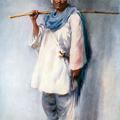
[Original caption] An inhabitant of North-West India unsurpassed as a hill fighter. Although Mahomedans, the Pathans rebelled against the Mogul Emperors round about the sixteenth century and were in consequence forced to keep to the hills. [end]
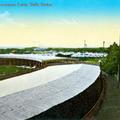
Although the word "concentration camp," has since been primarily associated with Nazi concentration camps during World War II (1939-1945), the word was in use earlier in wider contexts as a place where many people were concentrated in one location,
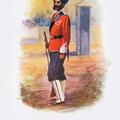
Another striking portrait by the great Indian artist M.V. Dhurandhar (1867-1944). This one was sent in 1905 by an Indian postcard collector, probably in Bombay, who pursued his hobby in a way that gives insight into early collector's fine tastes:
[
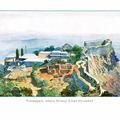
A rare landscape postcard by Dhurandhar, who is best known for his portraits of Bombay types.
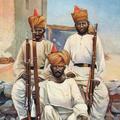
[Original caption] The native tribes of India have, since the first occupation of the country by the British, been trained to act as soldiers to guard their own districts.
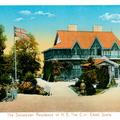
"Since the Viceroyalty of Sir John Lawrence in 1865 Simla has been the summer capital of the Government of India.
