Marwari
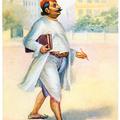
A moneylender strutting through the public square, carrying the ominous red books he uses to chase debtors through the courts, the vibrant city his backdrop.
A moneylender strutting through the public square, carrying the ominous red books he uses to chase debtors through the courts, the vibrant city his backdrop.
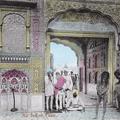
Although it is a single fakir at the doorway who is the subject of the postcard's title, it is the colors of the entrance to the Golden Temple in Amritsar that catch our eye.

From an unusual lithographic series, a marvelous rendition of a type still very active throughout the subcontinent and restaurants abroad.
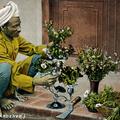
The word "mali" apparently comes from the Sanskrit "mala" or garland via Hindi. Malis seem to be generally shown crouching on postcards.
[Verso, handwritten] "Upper Burma, May 8/[19]18 My dear Annie, I am pleased to hear from Mother that you got some
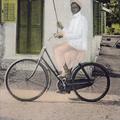
Or is he trying to keep cool? This series of humourous postcards seems to feature the same protagonist.
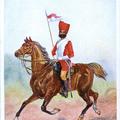
Formed in 1865, the Governor's Bodyguard was a colorful, often-illustrated cavalry in their red and white uniforms and mustachioed Rajput horsemen.
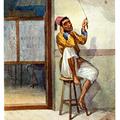
A key figure in the Raj was the punkha boy or man, who pulled the string that moved a fan in a bar or in the sleeping quarters to keep their employers cool.
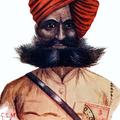
This artist-signed postcard includes a red French stamp, cancelled in 1930, in a slightly tilted position that might have meant, if the sender was adhering to The Language of Stamps, "Have you Forgotten Me?"
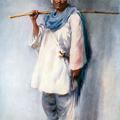
[Original caption] An inhabitant of North-West India unsurpassed as a hill fighter. Although Mahomedans, the Pathans rebelled against the Mogul Emperors round about the sixteenth century and were in consequence forced to keep to the hills. [end]
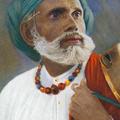
The term mendicant refers to begging or relying on charitable donations, and is most widely used for religious followers or ascetics who rely on charity to survive. Plate & Co.
