Loading a Bombay Cart
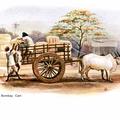
Initialed "MD" in the right corner, Dhurandhar deftly captures early Bombay life. The labourer on the cart nearly falls backwards as he pulls the box up. A pretty tree separates the bullocks from the cart.
Initialed "MD" in the right corner, Dhurandhar deftly captures early Bombay life. The labourer on the cart nearly falls backwards as he pulls the box up. A pretty tree separates the bullocks from the cart.
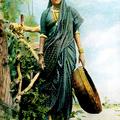
The growth of a city like Bombay was largely dependent on the work of laborers who carried bricks and building materials on wicker baskets on construction sites, much like they do today, which must be part of the reason why they were such common
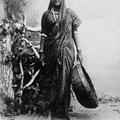
The original black and white postcard predating the color version.

A truly multi-purpose postcard by Paul Gerhardt.

An early lithographic card by the elusive Bombay lithographer and publisher W. Cooper. Like some of this other cards, it seems to have originated in a photograph also published as a postcard by The Phototype Co.

The photographic original of one-half of the lithograph A Fair Exchange by W. Cooper.
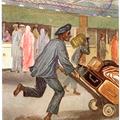
Like the backs of many Dhurandhar cards, this one bears the blind stamp and price ["A.H.W. Rs. 0-1-0," e.g. 1 anna] of A.H. Wheeler & Co., at 47 Hornby Road, the bookstall chain and contractor for advertising on Indian Railways.
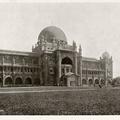
[Original caption] The Museum. As befitting an important town like Bombay, the Museum is, indeed, a very fine one, and contains many valuable collections. [end]
This postcard was likely printed soon after the construction of the Prince of Wales
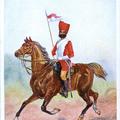
Formed in 1865, the Governor's Bodyguard was a colorful, often-illustrated cavalry in their red and white uniforms and mustachioed Rajput horsemen.
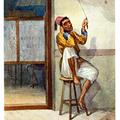
A key figure in the Raj was the punkha boy or man, who pulled the string that moved a fan in a bar or in the sleeping quarters to keep their employers cool.
