No Hobson's Choice at Taraporevala's
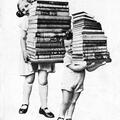
A clever advertising postcard from what what Bombay's leading bookseller and major postcard publisher at the turn of the century.
A clever advertising postcard from what what Bombay's leading bookseller and major postcard publisher at the turn of the century.
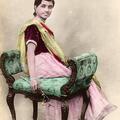
A melange of green, ink, red and yellow masterfully applied to a real photograph.
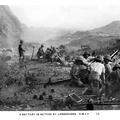
A postcard probably taken during the 3rd Afghan War in 1919 on the border between British India and Afghanistan; the battery was not far from camp shown in the background.
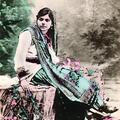
A skillfully done studio shot with real depth of field provided by the seating arrangement and sparse use of green, pink and white with a dash of glitter.
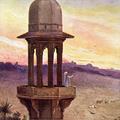
Although not signed, this may have been from a painting or drawing by Evelyn Stuart Hardy (1865?-1935) who illustrated a number of other "Child Life" series postcards for A. B. Shaw, a London printer and publisher.
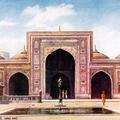
[Original caption] Wazir Khan's Mosque (Inner Part) Lahore. The mosque was designed in Hidayat-ul-lah, faithful servant of Wazir Khan and was built in 1634. The brick walls are covered with beautiful inlaid work, a kind of mosaic of glazed pottery
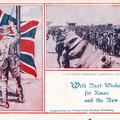
With Best Wishes for Xmas and the New Year
The fundraising postcard by a women's group in Bombay shows Turkish prisoners likely captured in 1917 when British Indian troops captured Baghdad and other areas of modern Iraq from the Ottoman Empire.
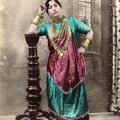
A unusual real photo postcard that is both hand colored and has glitter finely applied to the hems of the woman's dress. She is resting her arm on a magnificent pedestal that suggests a north Indian studio, possibly in Lucknow.
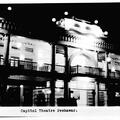
A rare night time photograph of an old cinema in the Saddar Bazaar area of Peshawar, said to have been founded around 1913 and demolished in 2020.
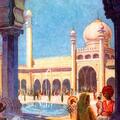
The British Empire Exhibition in 1924 was promoted with many a series of postcards by British publishers, including a series by the artist Ernest Coffin, of which this though unsigned seems to be an example.
