Telegraph Peon
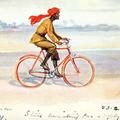
Another Dhurandhar postcard that captures the essence and humour of a telegraph peon using a bicycle to rush to his destination.
Another Dhurandhar postcard that captures the essence and humour of a telegraph peon using a bicycle to rush to his destination.
![[Karla Station]](https://www.paperjewels.org/sites/default/files/styles/square_thumbnail/public/slides/karla-station_0.jpg?itok=ktTgi9Gt "[Karla Station]")
This postcard shows a scene at the platform of Karla railway station outside Mumbai where The Ravi Varma Press was headquartered. On the platform, a barefoot man is holding a stick, another is smoking a hookah.

This image published by The Colombo Apothecaries is apparently based on an original albumen photograph taken in the 1870s or 1880s by the British photographer Charles Scowen who sold his negatives to the firm when he tried to become a planter in
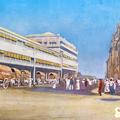
Tea was one of those commodities that benefitted from the marketing that came with postcards, going back to the late 1890s.
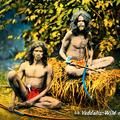
This postcard of the original inhabitants of Sri Lanka [Ceylon] was made from a photograph by Charles Scowen, one of the great photographers of the 19th century, as was likely taken in the 1870s.
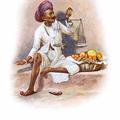
Note the rich character on this man's face in an image by M.V. Dhurandhar, one of India's most exceptional and prolific early 20th century painters and postcard artists.
Sent to Master E.
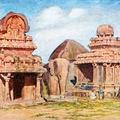
While we now believe that the temples date to the Pallava King Narasimharavan around 630 CE, much about their origins remains obscure. This is an embossed postcard, with the relief lines meant to simulate an old oil painting.
[Original caption] Seven
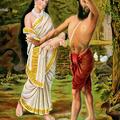
Vishvamitra was a revered sage in ancient India; this postcard from one of Ravi Varma's most famous paintings shows how he rejects knowledge of his child by turning away and hiding his gaze with a dramatic gesture.
[Original caption] Menaka sent by
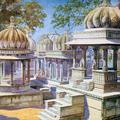
Burial monument of the 17th century Rajput rule, Maharaja Sawai Jai Singh (1688-1743) who built the state of Rajputana into a formidable independent kingdom, founded the planned city of Jaipur and founded major astronomical observatories both there
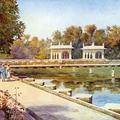
[Original caption] Shalimar Garden, Lahore. These gardens were laid out in 1637 by order of Shah Jehan. They are divided into three parts on different levels. The whole extent is about three parts on different levels.
