The Ayah
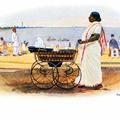
This postcard shows a nanny with a pram on the “Queen’s necklace” of Malabar beach in Bombay. The artist Dhurandhar and other fellow J.J.
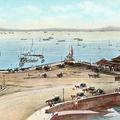
The pier across the Taj Hotel where the Gateway to India now stands. This area was expanded with a sea wall and entry steps before the Gateway to India was completed in 1924. The Japanese-style pavilion seen here was removed.
[Original] Victoria Brunnen
Compagnie Comet seems to have been the earliest publisher of a series of cards on India, their name appearing as "Verlag [Firm] "Compagnie Comet", Fr. Th.
Over a million Indian troops served as part of the British forces in World War I; postcards were used to help recruit them, often in languages like Gujarati, though this card seems to have been intended more for British troops already serving in
The Sri Lankan tea industry grew from 250 acres under cultivation in 1876 to almost 400,000 acres in 1900.8 Some 150 million tonnes of tea were produced in 1900 worth 50 million rupees, half of Ceylon’s total exports.
This card is from a series of 6 postcards by the unknown painter E.E. probably self-published around 1910. It is of unusual size, and came in a nice envelope with the imprinted title Six Artistic Views of Kashmir. Many British residents had some
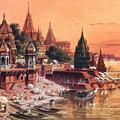
An rare French postcard of Benares [Varanasi], featuring fakirs debating and listening with the ghats in the background.
This postcard by the French artist Emile Dupuis honoured the Indian soldiers who fought with the Allies in in what is better known as the First Battle of Ypres in Belgium, an early World War I battleground where some 160,000 German soldiers died.
A magnificent postcard by the Australian painter Mortimer Menpes (1860-1938), based on a visit to India he made for the 1903 Darbar. An ageing warrior is given life by dazzling colors.
The early 20th-century Home Rule League demanded self-government for the whole of India from British rule and was particularly active between 1916-18. Many Indian leaders supported this movement including the famous nationalist, Bal Gangadhar Tilak.