
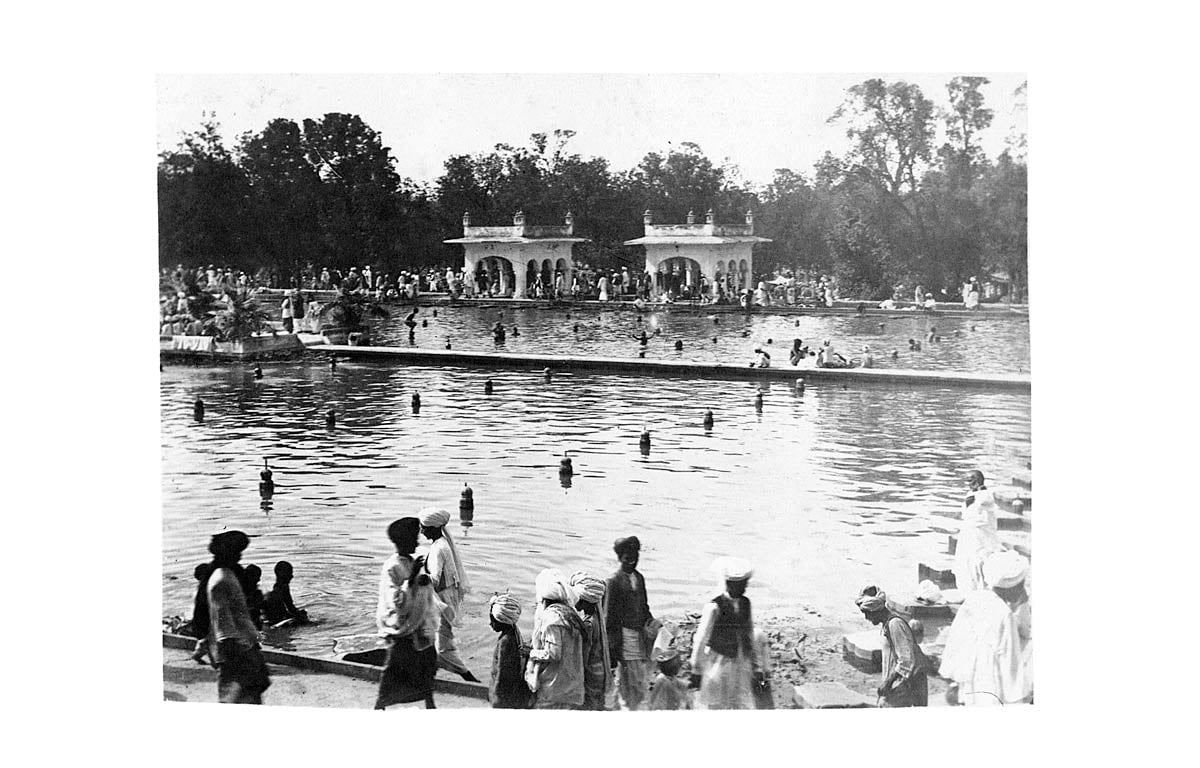
Hector Bolitho, the biographer who spent time in Pakistan in the early 1950s researching his book Jinnah: Creator of Pakistan (1954) wrote this about the Shalimar Gardens:
"While I was in Lahore I made a habit of rising at five o'clock each morning and driving to the edge of the city, to the Shalimar Gardens.In the first light of morning they were as entrancing as the fountains of Dresden; or Sans Souci, at dawn, when the marble statues seem to emerge, milk-white, naked, from sleep between the trees. Many of the exciting places I have known and remember most warmly seem to belong to the washed light of the new day: Greenwich Palace, seen across the Thames from Poplar, floating on the river edge, with shreds of night mist still dawdling in the morning light. Windsor Castle, seen at dawn as only the foresters and the deer see it, from the high level in the Great Park. Then it is not of grey stone, as Wyatt rebuilt it, but of gilt and ivory. Shalimar Gardens gave me similar pleasure:the white marble walls and fountains and pagodas, spaced by their Moghul builders with such sublime correctness over the surface of grass, catching the first splashes of brazen gold light that the Punjab enjoys.
You enter the gardens beneath a broad, deep arch, so that the full splendour is spread before you suddenly: the magnolia-petal turrets, the outer walls of red sandstone and creamy, confectionery marble; and the high, massive trees. Some of the trees are very old: they have seen, since they were little trees, the passing of Moghuls, Sikhs and Britons. Immemorial, sullen trees, surviving the follies of all the people who have struck attitudes, dreamed, or picnicked in their shade.
"Beneath the great trees, at dawn, are the only other men in the gardens, sweeping up the dead leaves: old men and coffee-brown boys,their panther thighs showing between the folds of their sparse clothes.I imagined that these little sweeping men perhaps lived in nests in the trees; that they were as old as the trees; a race of different animals,who slide down the trunks at dawn to sweep up leaves, all day, until, with the night, they climbed back into their nests to sleep. Servitors of the ancient trees, slithering down, snake-like, to sweep up the offending scales that fall from their masters, when summer goes. Theirs was the only sound-the taffeta silk whisper of their leaves, being brushed through the grass.
In the luxurious days when the Moghuls strutted here, the lawns were of clover. The grass lawns, mown and correct, were an English-Victorian-innovation. The Moghul kings must have looked very sumptuous and aloof, moving over the close-cropped clover-velvet of deeper green than grass. On hot days, the kings could order the four hundred and fifty fountains to be turned on; not only for beauty's sake, but because of much artificial rain, leaping up from the white marble basins, cooled the air and made the torture of the heat more tolerable.
As I moved from the shelter of the trees, and the company of the leaf sweepers, I came to the immense beds of canna lilies-each bed a battalion of red or yellow flags, with horizontal morning light shining through them so that the big petals were like flags of ruby or yellow glass. I cannot tell you how splendid they were; so immense and extravagant and fiery. Then came another sound, after the leaf sweepers-a hundred bright green parakeets, setting up such a fuss; a jubilee of little emerald birds, above the red and yellow flowers.Then another movement; the blossoms falling from the gold mohur trees; a rain of sealing-was red blossoms, falling among the cannas. When the birds had fled, I could hear the blossoms making faint bumps as they hit the lawn.
Beyond this exotic sight was another long bed of flowers, where hollyhocks and mayflowers grew, prim as in an English Vicarage garden.Then, as I came to believe my eyes, the Englishness was made more authentic by a cuckoo, with its silly noise. But, as I walked by the marble platform on which the Moghul kings no doubt sat, while the houris danced and the refreshing fountains played, the cannas and the green parakeets came into view again, and I believed that the Emperor Shah Jehan really walked here, sometimes bending down to touch the red roses, brought across the mountains, from Persia."
Quoted in Sharif Al Mujahid, In Quest of Jinnah Diary Notes and Correspondence of Hector Bolitho, Oxford University Press Karachi, 2007, p. 192-193.