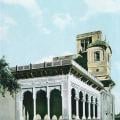
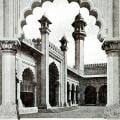
One of the most ornate and lavish rooms within the Lahore Fort. Built during the Mughal emperor Shah Jahan's 17th century reign, the Shish Mahal ("Shish" means mirror) is noted for its beautiful mirror work.
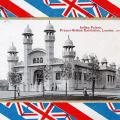
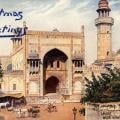
The Indian Pavilion at the 1924 British Empire Exhibition (Wembley) was designed as a major “showpiece” building in an Indo‑Saracenic/Mughal-revival idiom, explicitly modelled on iconic North Indian monuments (often described as drawing on the Jama…
After Ahmad Shah Durrani took Peshawar in 1747, Bala Hissar served as a royal residence for the Durrani Empire. This period is strongly associated with the fort’s role as an Afghan administrative and courtly center in the frontier city.
The Franco-British Exhibition of 1908, celebrating a new understanding on dividing up colonial interests between the two powers, came at the height of interest and production of the new medium of postcards.
A standard depiction of the colony as a trunk full of raw materials, this series seems to have been started in the 1900-1910 period and persisted into the 1940s.
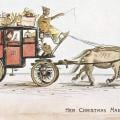
[Original handwritten message, verso] "25/11 Dear David, These are the funny old carriages which we see every day in Calcutta. The old lady has been shopping for Christmas."
The London based publisher F. Hartmann, best known as an indigo merchant, also claimed to be the first British-based publisher of postcards of India as early as 1903.