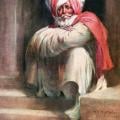
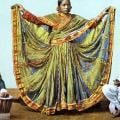
[Original caption] A member of the ancient Hindu fighting race which flourished and conquered mainly in Western and Northern India in the twelfth century. [end]
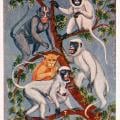
"It was curious, for example, to hear us spoken of as ‘the Monkey People’," wrote longtime Punjab I.C.S. Officer Sir Malcolm Darling in his memoir. He continued:
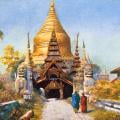
[Original caption] Sheveegeena Pagoda, Pagan, Burmah. The golden pagoda at Pagan, 900 years ago, of the Burmah empire. The site is now a desert, forced labour employed for the building of these temples having ruined its prosperity. [end]
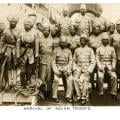
Indian troops arriving to support Britain in World War I. While the arrival of Indian troops was a boost to the morale of British and European forces fighting the Germans, Austrian and Turkish forces, it was also an eye-opening experience for those…
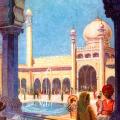
Although not signed, this may have been from a painting or drawing by Evelyn Stuart Hardy (1865?-1935) who illustrated a number of other "Child Life" series postcards for A. B. Shaw, a London printer and publisher.
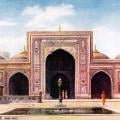
[Original caption] Wazir Khan's Mosque (Inner Part) Lahore. The mosque was designed in Hidayat-ul-lah, faithful servant of Wazir Khan and was built in 1634.
The British Empire Exhibition in 1924 was promoted with many a series of postcards by British publishers, including a series by the artist Ernest Coffin, of which this though unsigned seems to be an example.
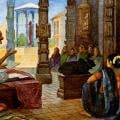
This image by the Indian painter M.V. Dhurandhar manages to convey a real sense of personality and drama to the situation through the face and gesture of the priest.
[Verso, handwritten] "C.S.MS Missionary, now retired. So sorry, I forgot to provide stamps on the envelope I posted yesterday. I enclose 2 to make amends. With love A."