Sharif al Mujahid in his book In Quest of Jinnah Diary, Notes and Correspondence of Hector Bolitho (pp. 51-2), which collates many unpublished pieces by Jinnah's first biographer, includes this excerpt dated 11 April [1952]:
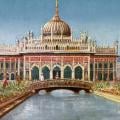
Chota Imambara, a Lucknow landmark, is also called the Husseinabad Imambara. This monument, built as the mausoleum for Muhammad Ali Shah, was completed in 1837 and is part of the Kaiser Bagh complex.
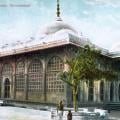
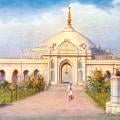
[Original caption] Shah Najaf Mosque. Lucknow. Shah Najaf is the tomb of Ghazi-ud-din Haider Khan, surmounted by a dome and surrounded by walls of such immense thickness that the heavy guns of the Naval Brigade were unable to make any impression on…
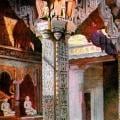
[Original caption] Jaipur - The Holy Shrine of Singhji. Jaipur is one of the wealthiest and best administered states under native rule. Its capital, the 'rose-red city' of that name is picturesque, clean, prosperous and progressive.
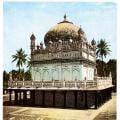
Tipu Sultan, perhaps the last formidable ruler the British had to defeat before taking over South India was killed on May 4th, 1799 at the end of the Fourth Anglo-Mysore War.
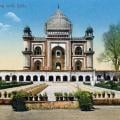
The low angle of this splendid postcard of the mid-18th century tomb of Nawab Safderjung seems to widen at the bottom and reach towards the viewer. Note the two figures in white, almost invisible against the whitewash of the pedestal.
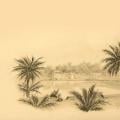
This unusual, sepia-ish lithographic postcard is probably by Paul Gerhardt at the Ravi Varma Press even though it is not signed by him with the Press imprint.
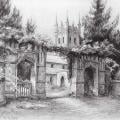
An unusual artist-signed postcard of All Saints Church in Coonoor, established in 1854. Very finely done, it is among the limited examples British amateur artist trying their hand at something often self-published on a postcard.