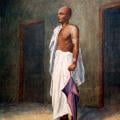
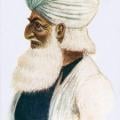
The term mendicant refers to begging or relying on charitable donations, and is most widely used for religious followers or ascetics who rely on charity to survive.
The word "peon" owes its origin to the Spanish word which means laborer. Although peons in European society were considered somewhat lowly in status, in India at the turn of the century peons were white collar employees who could, over time, rise in…
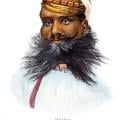
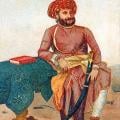
A rare Dutch lithographic postcard showing what is likely a Rajput prince or warrior. Note the very skillful use of the white background to extend the man's shirt.
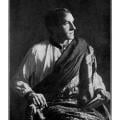
[Original back of advertising card] Alastor-Mystic-The Astrologer, Handreader and Clairvoyant from England. May be Consulted Daily at the Great Eastern Hotel, Calcutta, Room 59. (Hours 10 A.M. to 7 P.M. or by Appointment).
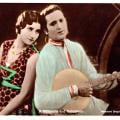
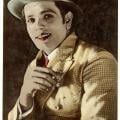
One of early Indian cinema's most famous silent and sound film actors, Dinshaw Billimoria, shown here with his favorite co-star and romantic lead, Sulochana (also known as Ruby Myers).
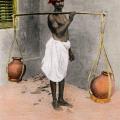
Today goatskins, pigskins and earthen pitchers have given way to plastic jars and bottles and huge, lumbering dripping water tankers that supplement inadequate piped water supplies in towns and cities throughout South Asia.
An unusual lithographic postcard, blind stamped across the entire back "Haji Yusuf Haji Mohammed Pictures, Post-cards and Cutlery Merchant. Grant Road Cross-Lane. Bombay, 7" that suggests this firm may have been the publisher.
P.K. Raja Sandow (1894/5-1943) was one of the most famous silent film actors of India, and later a producer and director as well. Born in Tamil Nadu, he was given the name "Sandow" after a well-known German body-builder of the time.
One of siz postcards in Raphael Tuck & Sons first "Native Life in India" series, which featured the work of an artist with the initials G.E.M. who remains unidentified.