Railway Porter
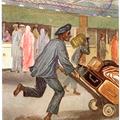
Like the backs of many Dhurandhar cards, this one bears the blind stamp and price ["A.H.W. Rs. 0-1-0," e.g. 1 anna] of A.H. Wheeler & Co., at 47 Hornby Road, the bookstall chain and contractor for advertising on Indian Railways.

Like the backs of many Dhurandhar cards, this one bears the blind stamp and price ["A.H.W. Rs. 0-1-0," e.g. 1 anna] of A.H. Wheeler & Co., at 47 Hornby Road, the bookstall chain and contractor for advertising on Indian Railways.
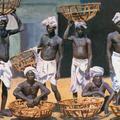
[Original caption] Calcutta Coolies. The Coolies of Calcutta, otherwise porters or carriers, are men of fine physique, and are able to carry exceptionally heavy weights supported on their heads.

Although a coolie – "a hired labourer, or burden-carrier"(Hobson-Jobson, p. 249) – were at the bottom of the social ladder, and the word is said to originally come from Kolis, a hill-people in the Western Ghats, "whose savagery, filth and general
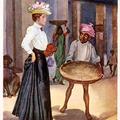
A postcard by the great Indian painter M.V. Dhurandhar illustrating an Englishwoman looking over a coolie offering his services with an empty basket. Note the cleverly positioned Indian woman with a basket on her head in the background.
The message
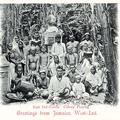
A postcard showing Indian workers ("east Indian coolies") brought to work in Jamaica (the "West Indies") to work, part of an enormous migration of Indian labor to British colonies around the world, many of whose descendants are still living in places
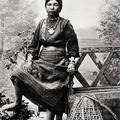
"The professional photographers of Darjeeling generated innumerable prints depicting those whose toil supported the lifestyles of the colonialists in their homes and businesses, and who created products they loved to consumer," writes Claire Harris
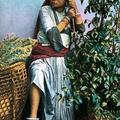
Postcards of the tea industry were popular in the early 20th century and helped spread consumption of the product grown in northeast and South India and Ceylon [Sri Lanka]. Women and children often picked the tea leaves, and this worker, likely from
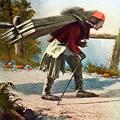
Kolkata-based Bourne & Shepherd was one of the oldest photographic studios in India, and certainly one of the most famous, having built its reputation on the albumen photography of Samuel Bourne during the 1860s.
