Marwari
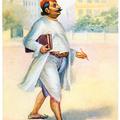
A moneylender strutting through the public square, carrying the ominous red books he uses to chase debtors through the courts, the vibrant city his backdrop.
A moneylender strutting through the public square, carrying the ominous red books he uses to chase debtors through the courts, the vibrant city his backdrop.
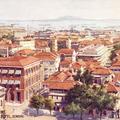
[Original caption] Bird's Eye View of Fort from Taj Mahal Hotel, Bombay.
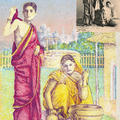
A very early postcard printed in India (postmarked Dec. 1902 in one instance) by the lithographer W. Cooper. The chance discovery of another photographic postcard shows how a scene like this was composed.
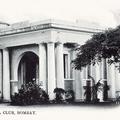
A postcard where the angle and architecture combine effectively to represent the role an institution once played in India's political and social life.
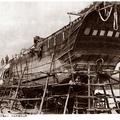
An atypical postcard that shows a ship in dry dock.
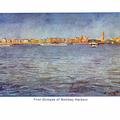
A rare landscape postcard by M.V. Dhurandhar; the vast majority of the seventy or so postcards he painted during this period were of people. Rajabai Clock Tower is visible on the right.
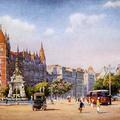
[Original caption] Bombay, unlike most of the other shipping towns of importance, is not situated upon a river.
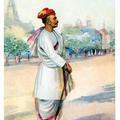
The Brahmin, as the art scholar Allan Life has noted, is reluctantly shuffling from tradition to modernity, from the temple behind him to the new city in front of him.
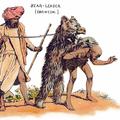
A very early lithographed card by Paul Gerhardt, who ran the lithographic printers at the Ravi Varma Press.
Sent to Miss Ettoi Virmillion, 52 West & South, Salt Lake City, Utah, USA, via San Francisco: [Recto] "Bombay 22 March 1905. Very bare. Will"
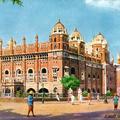
[Original caption] General Post Office - Here is to be found a very fine building and an immense amount of business is transacted here. [end]
Opened in 1913, with a central dome modelled after the Gol Gumbaz in Bijapur, this remains one of the iconic
