Patiala State Court
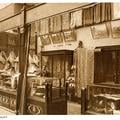
The Patiala State Court was one of the “courts” within the Indian Pavilion at the British Empire Exhibition in Wembley, 1924, a state-branded display space for Patiala’s produce, crafts, and commerce.

The Patiala State Court was one of the “courts” within the Indian Pavilion at the British Empire Exhibition in Wembley, 1924, a state-branded display space for Patiala’s produce, crafts, and commerce.
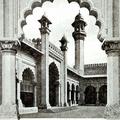
The Indian Pavilion at the 1924 British Empire Exhibition (Wembley) was designed as a major “showpiece” building in an Indo‑Saracenic/Mughal-revival idiom, explicitly modelled on iconic North Indian monuments (often described as drawing on the Jama
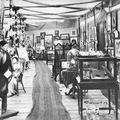
In 1905, a significant exhibition was organized in Bombay (now Mumbai) that marked an important moment in India's colonial and nationalist history. Planned to commemorate the visit of the Prince of Wales (later King George V) to India.
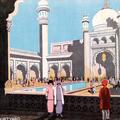
This promotional postcard for the British Empire Exhibition in London in 1924 was signed by Ernest Maitland Coffin (1868-1944), apparently a successful commercial artist.
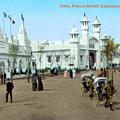
An official postcard from what was the largest exhibition ever held in London, and the first organized by two nations together. It drew some 8 million visitors to an area known later as "White City" because all the buildings were painted white.
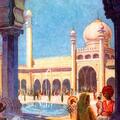
The British Empire Exhibition in 1924 was promoted with many a series of postcards by British publishers, including a series by the artist Ernest Coffin, of which this though unsigned seems to be an example.
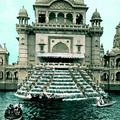
Postmarked Oct. 7, 1908, Birmingham and sent to Miss Jeffreys, 1, Northfield End, Henley-on-Thames [UK]: "Monday. Dear Auntie, Have you been to the Exhibition yet we have and it is Grand.
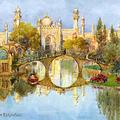
[Original caption] Through the portals of the INDIAN PAVILION twentieth-century London is left behind and the visitor enters the atmosphere of mystery and romance which characterizes the East.
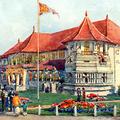
[Original caption]The Ceylon Pavilion with its four entrance lamps at Kandy is a faithful copy of the old Kandyan style of architecture, the panels and circular moonstones of the doorway having been rbought from Ceylon.
