The Cattle Show at Pushkar, Ajmer

An embossed frame sets off a rare early postcard of what is presumably the famous Pushkar fair, with the colonial perspective of a onetime owner scrawled across the top: "Does not look much like our Cattle Shows."
An embossed frame sets off a rare early postcard of what is presumably the famous Pushkar fair, with the colonial perspective of a onetime owner scrawled across the top: "Does not look much like our Cattle Shows."
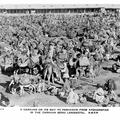
[Original] A Caravan on Its Way to Peshawar from Afghanistan in the Caravan Serai Landikotal N.W.F.P. [end]
Postcards like this illustrate how enormous the trade through the Khyber Pass once was. The Peshawar District Gazetteer 1897-98 put the value

A nice representation of water being extracted and transported by human and animal labor throughout a village.
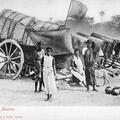
Note the diagonal leading the eye into a rich scene, the figures in the corners of the frame, the tethered cow on the left, the pots in the coals, the vibrancy of this human space under a hoisted banner.
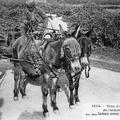
"The Indian experiences in France were the most extensive and, by and large, the happiest.
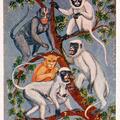
"It was curious, for example, to hear us spoken of as ‘the Monkey People’," wrote longtime Punjab I.C.S. Officer Sir Malcolm Darling in his memoir. He continued:
"Nor was it altogether palatable to be told by a highly educated Brahmin—‘you (that is,
![Elephant hunting tiger [handwritten]](https://www.paperjewels.org/sites/default/files/styles/square_thumbnail/public/slides/tiger-hunting_0.jpg?itok=Ee9xwwdY "Elephant hunting tiger [handwritten]")
A hand painted postcard of a favorite sport for Indian Maharajahs, British colonial officials and well-heeled tourists.
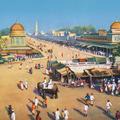
[Original caption] Street Scene. The city of Jeypore, situated 850 miles north-west of Calcutta, is handsomely and regularly built, and is the most important centre of Rajputana.
![[Child and Dog]](https://www.paperjewels.org/sites/default/files/styles/square_thumbnail/public/slides/child-and-dog.jpg?itok=88BXTF5X "[Child and Dog]")
A most unusual postcard of a colonial family's two beloved creatures, carefully composed together in the studio, ready for the girl's family to send to relatives.
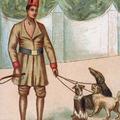
One of the many – to Indians, curious – new professions that sprouted in the growing city of Bombay at the turn of the century.
