Loading a Bombay Cart
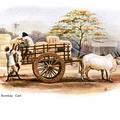
Initialed "MD" in the right corner, Dhurandhar deftly captures early Bombay life. The labourer on the cart nearly falls backwards as he pulls the box up. A pretty tree separates the bullocks from the cart.
Initialed "MD" in the right corner, Dhurandhar deftly captures early Bombay life. The labourer on the cart nearly falls backwards as he pulls the box up. A pretty tree separates the bullocks from the cart.
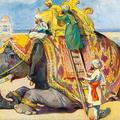
An early painted postcard, part of a series commemorating the 1903 Delhi Durbar but abstracted to something broader as "The Gorgeous East" series; note the water in the background which likely would not have been part of the Delhi Durbar.
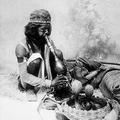
Not many snake charmers make it into a photographer's studio, but here the soft floral backdrop and line of the flute reinforces the sense of the cobras emerging gracefully from their basket.

[Original caption] A Kerzawah is a popular method of transport in the Indo-Afghan frontier, the camel being the usual beast of burden, and able to carry four persons in a load.
![Camel Driver [handwritten]](https://www.paperjewels.org/sites/default/files/styles/square_thumbnail/public/slides/camel-driver_0.jpg?itok=USOI-i0C "Camel Driver [handwritten]")
A hand painted postcard from roughly 1905, many of which like printed postcards illustrated the various labor occupations.
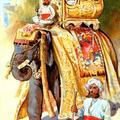
An early Tuck's painted postcard made to celebrate the 1903 Delhi Darbar. Viceroy Lord Curzon and his wife Mary are atop the elephant, their arrival opened the Darbar.
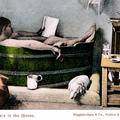
A postcard that sums up the fantasy of colonial life for Europeans. The dog resting by the tub is to Indians most unhygienic, but to Europeans the ultimate Raj bathroom accessory.
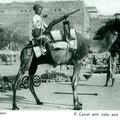
One of the more unusual forces in Rajputana during the Raj was the Bikaner Camel Corps which "had such camels also on which 'jujarbas' or small cannon were mounted" (Nandakiśora Pārīka, Jaipur that was: royal court and the seraglio, p.
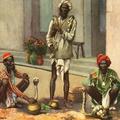
[Original caption] Snake Charmers, Calcutta. The Snake Charmer, as a rule, is an itinerant being, who is glad to charm his snakes in your compound, or before your house or bungalow, for a small reward.
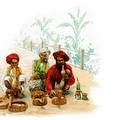
Snake charmers are one of the most common early Indian postcard subjects, and this must be one of the earliest and most beautiful such views. Note the clever use of the palm backdrop to create the illusion of depth, and the rich use of red.
