Clive Street, Calcutta
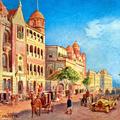
[Original caption] Clive Street, Calcutta.
[Original caption] Clive Street, Calcutta.
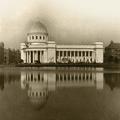
Sepia postcards were printed in a brown colour instead of black inks, and went in and out of fashion from the early 1900s through the 1940s.
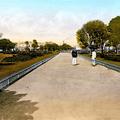
The garden in front of the Victoria Memorial is sometimes still called Curzon Gardens.
Lord Curzon was the Viceroy of India from 1899 to 1905. He constructed Victoria Memorial in memory of Queen Victoria, the British monarch who died in 1901 after
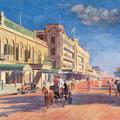
[Original caption] “Chowringhee, Calcutta. Chowringhee Road runs past the sumptuous edifice of the Bengal Club and the nest residential quarter of Calcutta to St. Paul’s Cathedral.
![[Calcutta Harbour on the Hooghly]](https://www.paperjewels.org/sites/default/files/styles/square_thumbnail/public/slides/calcutta-old_0.jpg?itok=WWJ-6Vwf "[Calcutta Harbour on the Hooghly]")
An early and rare early photo postcard, made with a photograph pasted on card stock.
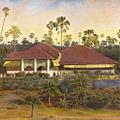
An Indian Bungalow or single story house.
The word bungalow derives from the Gujarati word baṅglo and means "Bengali", used to communicate "house in the Bengal style". Such houses were traditionally small, thatched and had a wide veranda.
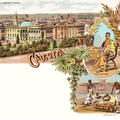
One of the earliest postcards of India, Calcutta, published by W. Rossler, a German or Austrian photographer in the city in 1897. Lithograph, Court sized, Printed in Austria. Undivided back.
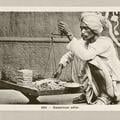
The mithai-wala was a popular postcard subject; in this composition the textile pattern behind the man gives the image energy even as the man stares somewhere far away.
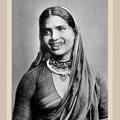
Smiles on postcards from the early 1900s are rather rare, possibly because most portraits required the sitter to stay still for many seconds while the exposure was made, especially in the 19th century when most portraits were struck and re-purposed
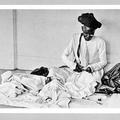
Nestor Gianaclis, like D. Macropolo & Co., another Greek-owned firm, was not primarily a photographer so much as a Greek tobacco merchant whose Calcutta office also issued collotype picture postcards and photographic prints in the early 1900s.
