India Tea Growers Post Card [back]
![India Tea Growers Post Card [back]](https://www.paperjewels.org/sites/default/files/styles/square_thumbnail/public/slides/tea-card-back_0.jpg?itok=zMlAOWq1 "India Tea Growers Post Card [back]")
The back of the Mumtaz-i-Mahal postcard, with an advertising message for tea and the ink stamp of the sales agent.
The back of the Mumtaz-i-Mahal postcard, with an advertising message for tea and the ink stamp of the sales agent.
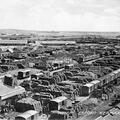
By 1899, Karachi had become the largest wheat and cotton exporting port in South Asia. The port's significance in wheat exports grew rapidly, and by 1910, Karachi handled greater quantities of wheat than any other port in the British Empire.
![Bara Bazaar. Hyderabad, Dn. [Deccan]](https://www.paperjewels.org/sites/default/files/styles/square_thumbnail/public/slides/bara-bazaar_0.jpg?itok=260YDe5R "Bara Bazaar. Hyderabad, Dn. [Deccan]")
A lovely postcard were the energy flows outwards towards the viewer from the Char Minar, the city's landmark mosque built in 1591.
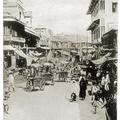
A candid Delhi shot by a little-known photographer.
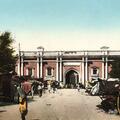
One of the most distinctive features of South Asian cities throughout history has been the named city gates facing other major trading partners. Delhi Fort, for example, has its Lahore Gate.
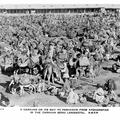
[Original] A Caravan on Its Way to Peshawar from Afghanistan in the Caravan Serai Landikotal N.W.F.P. [end]
Postcards like this illustrate how enormous the trade through the Khyber Pass once was. The Peshawar District Gazetteer 1897-98 put the value
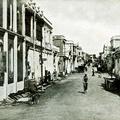
A popular image of Commercial Street in Bangalore by one of its most popular studios run by M. C. H. Doveton. Note that the poster on the left has the word "War" readable which suggests it is from around the first World War I period.
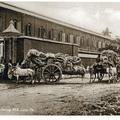
Jute was one of the major agricultural products during the Raj and for some period afterwards, with most of the crop grown in East Bengal, and the fiber processed in mills in and around Kolkata.
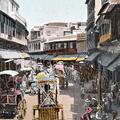
A hand-coloured postcard of Delhi by one of the earliest London-based publishers of Indian postcards.
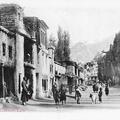
Probably one of the earliest if not the earliest postcard of Leh, capital of the former Kingdom of Ladakh. Little is known about R. E. Shorter, a photographer with offices in Sialkot, Punjab, on the route to Kashmir, and Kashmir.
