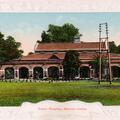
Corstorphans Hotel, Simla

While this postcard is from the early 1900s, as late as 1938 Murray's Handbook for India, Burma and Ceylon still recommended Costorphan's Hotel, with Cecil (Faletti's), Grand and Elysium to its travelers to the hillstation.

While this postcard is from the early 1900s, as late as 1938 Murray's Handbook for India, Burma and Ceylon still recommended Costorphan's Hotel, with Cecil (Faletti's), Grand and Elysium to its travelers to the hillstation.
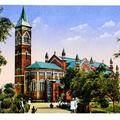
The Memorial Church in Kanpur is also called "All Soul's Cathedral"
Kanpur Memorial Church was erected in 1875 in the memory of British soldiers and civilians who died during the 1857 War of Independence or what the British called the Mutiny.
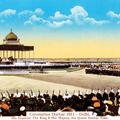
One of an extensive set of series H.A. Mirza & Sons, Delhi's leading photographer and postcard publisher at the time, made of the Darbar.
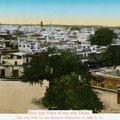
[Original] This city built by the Emperor Shahjahan in 1627 A.D. [end]
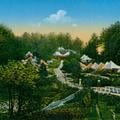
Upper Topa in the Murree Hills was established by the British during colonial rule as a military base, and today hosts the Military College Murree at an altitude of over 2,000 metres.
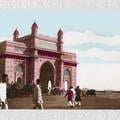
A triumphal arch erected to commemorate the visit of King George V and Queen Mary in 1911, it was completed in its present form in 1924. The Gateway of India was built in the Indo-Saracenic architectural style, combining multiple design elements and
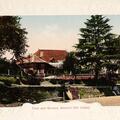
A thickly embossed and framed postcard, a treatment that seems to be more prevalent among hillstation postcards.
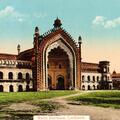
Rumi Darwaza is an iconic gateway located in the heart of Lucknow, India.
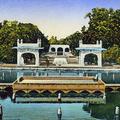
The beautiful gardens adjacent to the present-day Pakistan-Indian border were build during the reign of the Mughal Emperor Shah Jahan.
Built in the year 1641 A.D, the Shalimar Gardens in Lahore are a UNESCO World Heritage Site.
Hospitals found there way on to many postcards, symbols of progress that probably reflected colonial health concerns.
