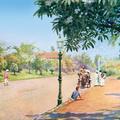
Native Quarter, Null Bazaar, Bombay
[Original caption] Native Quarter, Null Bazaar, Bombay. One of the principal highways, is typical of the many animated thoroughfares of this busy city.
[Original caption] Native Quarter, Null Bazaar, Bombay. One of the principal highways, is typical of the many animated thoroughfares of this busy city.
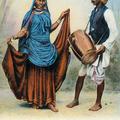
[Original caption] An Afridi Girl. The Afridis are an Afghan or Pathan people, numbering about 300,000, inhabiting the moutainous region south of the Hindu-Kush. They consist of a number of separate clans, often at feud with each other.
Rope bridges, a death-defying way of sliding across rivers and canals in Kashmir were described by the American photographer James Ricalton: "Among the Himalayas several kinds of primitive bridges are in use; there are two kinds here before us now.
[Original caption] Madras, Cocoanut Oil Mills.
This real photo postcard has a "Copyright, Made in Germany" imprint on the back, which was likely printed in India on German postcard-size paper. The watercolor and glitter treatment could also have been done in-house.
Possibly a dancer in a nicely hand-tinted postcard; note the red tip of the plant pointing to the lady.
There are very few Dutch postcards, let alone early ones, of India, but this is a splendid exception.
Timber was mostly used as a building material and for making furniture. Power tools and machines are available to make life easier for carpenters today, but a century ago, specialized workmen plying their trade were a popular postcard theme.
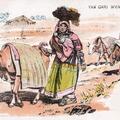
A drawing by the painter M.V. Dhurandhar that animates the meaning of "syce" as having to do with "coaxing." It was defined by Hobson-Jobson (1906): "SYCE (p. 885) SYCE , s. Hind. from Ar. sāïs. A groom.
A real photo postcard likely made and sold by a photographer or vendor to tourists visiting Jaipur.